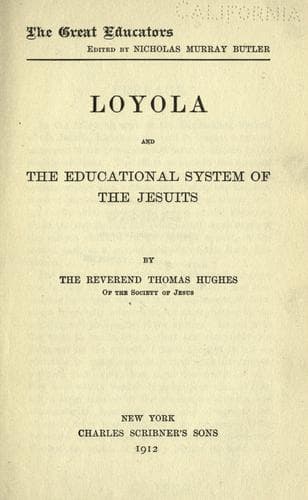
Loyola and the Educational System of the JesuitsHughes, Thomas
History
Loyola and the Educational System of the Jesuits
Hughes, Thomas
Education -- History; Ignatius, of Loyola, Saint, 1491-1556; Jesuits
Ignatius, after a year more or less spent at Manresa, took his
pilgrim's staff and journeyed on foot to Italy, and thence to the Holy
Land. It was in the spirit of the old Crusaders, whose chivalry had
a charm for him up to the day many years later, when, with his first
associates of the Company, he endeavored once more to cross over from
Italy to Palestine. Had he succeeded on this later occasion, he would
most probably never have known the others who attached themselves to
him; nor might history have busied itself with him or with them.
At the date of his return from the Holy Land, we find that he has
advanced already to the second lesson in the development of his future.
It is, that mature in years as he is, and full of desires for doing
good to his neighbors, yet neither does mere piety place in his hands
the instruments for such work; nor, if study alone can give the means
of apostolic zeal, can he consider himself exempt from the law, that
he must labor to acquire what are only the results of labor. He was
thirty-one years of age, when he betook himself, after his night's
vigil, to the cave of Manresa. He is two years older now. So, at the
age of thirty-three, he sits down on the school-bench at Barcelona, and
begins his Latin declensions.
Begrudging his studies the time which they demand exclusively, he
mistakes the situation, and allows himself the exercises of an
apostolic life. At his age, even supposing his earlier pursuits to have
been more in harmony with his present life of letters, he is not an apt
pupil. However, he labors conscientiously. After two years spent at
Grammar, he is judged by his teacher, who takes a lenient view of the
case, to be competent for approaching his higher studies.
He himself was dubious. His friends recommended him to ascend. He
still hesitated. But, receiving the same favorable opinion from a
theologian whom he consulted, Ignatius acquiesced, in accordance with
his unvarying rule, to follow competent direction. How unfortunate this
step was for the happy progress of his studies, but how advantageous
for his experience as a future legislator, I shall proceed to show.
Leaving Barcelona for Alcalà, he meant to enjoy the best advantages
which a great university could afford. He lived on alms as ever; and
others lived on the alms which he received. It was the year 1626. He
entered upon the study of Logic, using the Summa of Di Soto; also the
Physics of Aristotle; and he pursued besides the Master of Sentences.
Public-domain text, read in full here on John Shaqi.
Reviews
Reviews
No reviews yet
Be the first to share your thoughts on this work.
Join the Discussion
Join the discussion
Sign in to leave a comment or review.
Sign InorCreate an account