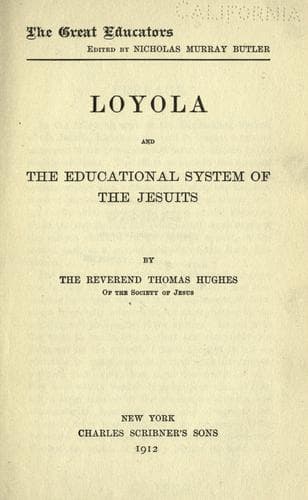
Loyola and the Educational System of the JesuitsHughes, Thomas
History
Loyola and the Educational System of the Jesuits
Hughes, Thomas
Education -- History; Ignatius, of Loyola, Saint, 1491-1556; Jesuits
mother tongue; or it may be added, as an appendix, to a shorter theme.
Let the boys hold a discussion among themselves upon the merits of
the translation; they can write in that narrative style, to win the
best places in class; as also, at the close of the year, for the
premiums. However, the whole time of class is not to be taken up by
such translations, as happens sometimes with negligent Masters, who
shirk the labor of the prelection, and of the correction of themes.
While the boys dispute among themselves on the precepts of grammar,
poetry, or eloquence, one stands against many, or several against
several. The subject, time, and manner of the _concertatio_ is to be
defined beforehand; umpires and judges are to be appointed, prizes for
the victors, penalties for the vanquished. The others, who are merely
listening during the contest, will show in writing what fruit they have
derived from it, or will be asked questions thereupon."[302]
In the following article,[303] the same writer gives several specimens
of a prelection in Cicero, Virgil, Phædrus, as adapted to the different
classes. They are only passages. The whole of this system goes by
passages, taken consecutively, until a whole piece has been mastered
by the students. For it is in the prior perfection of detail that
perfection in a larger compass is attained. And we may also note
that it is only in the original productions of perfect Masters in
style, that detail can ever be adequately studied. The understanding
and enjoyment of an entire masterpiece, taken as a whole, is by every
law of nature and of art an easy resultant of understanding the
parts. If any writers on pedagogy have thought that no student could
"understand and take pleasure" in an original classic, and therefore
have advocated the reading of translations as a means of receiving the
"literary impressions," I fear that we need only point to the style
of literary writing which seems to have resulted from doing things in
this second-hand fashion--if indeed it is even second-hand. For, after
all, style itself never appears in a translation; only the thoughts
are translated. Thoughts are the soul of style; its expression was
the body; each fitted the other in the classic original; and, in an
eminent mutual fitness, an eminent style was being studied. The best
translation of a classic piece has never done more than produce a bare
equivalent. Wherefore, if with the striking original no thorough work
has been done, it is more than probable that, in the results, nothing
original and striking will ever be done.
Public-domain text, read in full here on John Shaqi.
Reviews
Reviews
No reviews yet
Be the first to share your thoughts on this work.
Elsewhere in the archive
Join the Discussion
Join the discussion
Sign in to leave a comment or review.
Sign InorCreate an account