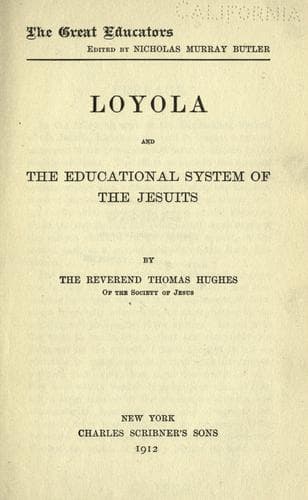
Loyola and the Educational System of the JesuitsHughes, Thomas
History
Loyola and the Educational System of the Jesuits
Hughes, Thomas
Education -- History; Ignatius, of Loyola, Saint, 1491-1556; Jesuits
This system of prelection, which in addition to the perfection of its
_technique_, required erudition from every branch of learning,[304]
made of the Professor anything but a technical pedagogue. Voltaire
noticed it, speaking of his own Professor. "Nothing will efface
from my heart," he wrote to Père de la Tour, Rector of the Collège
Louis-le-Grand, "the memory of Father Porée, who is equally dear to
all that studied under him. Never did man make study and virtue more
amiable. The hours of his lessons were delicious hours to us. And I
should have wished that it was the custom at Paris, as it used to be at
Athens, that one, at any age, could listen to such lectures. I should
often go to hear them. I have had the good fortune to be formed by more
than one Jesuit of the character of Père Porée, and I know that he has
successors worthy of him."[305]
The productions of such Professors replenished the literature of
the classics, as we may see in the great editions, or _bibliothecæ
classicæ_, published during the present century. Father De la Cerda
of Toledo, in his three folio volumes on Virgil, in 1617, gave to
literature an encyclopædia of political and moral observations,
including geography, history, and the natural sciences.[306] His
technical work was not inferior; for his "Grammatical Institutions"
became in 1613, by an exclusive privilege, the standard of all the
public schools in Spain. Father Nicholas Abram, whose "Epitome
of Greek Precepts in Latin Verse" went through fifty editions in
twenty-two years, published in 1632, while Professor at the College
of Pont-à-Mousson, two volumes octavo on Virgil, which were then
republished constantly at Rouen, Paris, Toulouse, Poitiers, Lyons,
etc.[307] Undertaking the same labor, in behalf of Cicero, he issued
two volumes folio, "by which John George Grævius profited in his
edition of Cicero, Amsterdam, 1699; as well as the editor of Cambridge,
whose work appeared in 1699, 1710, and 1717."[308] Father De la Rue's
(Carolus Ruæus) Delphin Virgil is a familiar work in France, Holland,
England; so, too, De Merouville's Delphin edition of Cicero, which was
often reproduced at Cambridge, London, Dublin, etc. The same we see
with regard to Sanadon on Horace, Brumoy's great work on the Greek
Drama, René Rapin's various critical and poetical works; and so of
the rest. Of Père Rapin's thirty-five works, there are few which were
not translated into various European languages; and Oxford, London,
Cambridge, have been among the most active centres of republication, or
translation into English.[309]
Public-domain text, read in full here on John Shaqi.
Reviews
Reviews
No reviews yet
Be the first to share your thoughts on this work.
Elsewhere in the archive
Join the Discussion
Join the discussion
Sign in to leave a comment or review.
Sign InorCreate an account