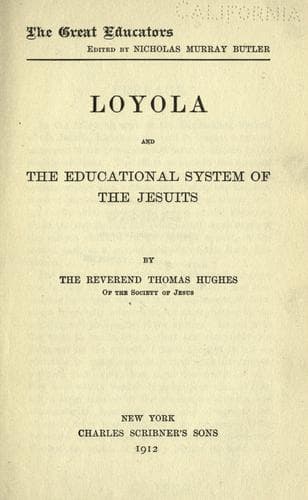
Loyola and the Educational System of the JesuitsHughes, Thomas
History
Loyola and the Educational System of the Jesuits
Hughes, Thomas
Education -- History; Ignatius, of Loyola, Saint, 1491-1556; Jesuits
4. This chapter, which has extended beyond the usual limits, cannot
close better than with a word on books, a matter intimately connected
with its subject. The Fathers of 1586 set down some principles
with regard to the proper supply and use of books, as well as the
expurgation of the classical standard works;[310] and accordingly the
_Ratio_ of 1599 ordains that "the students are neither to be without
useful books, nor to abound in useless ones."[311] A multitude is
considered useless, because "it oppresses the mind, and interferes
with the convenient preparation of the lesson. Of books by more recent
authors few are to be allowed, and those very carefully selected."
Yet, "a variety of authors gives a richer vein to the boys, and makes
imitation easier."[312] Here the Fathers proceed to give directions
for the composition of an entirely new kind of work, which would be
of great use in the colleges. It is exactly the species so well known
in our days under the various titles of "Precepts of Rhetoric," "Art
of Composition," etc. As the development of pedagogical literature,
which we took note of in a former chapter,[313] had already made some
progress, the critics say: "Some one most versed in all these matters
should be deputed to gather whatever is best in this line, and to
compile in one treatise, written in an elegant style, all that he has
selected, about the art of writing epigrams, elegies, odes, eclogues,
_sylvæ_ (that is, materials, "objects"), comedies, tragedies, epopoeiæ,
a brief method of chronology; explaining also what is the historical
(or narrative) style, the poetic, the epistolary, the different
kinds of speaking, and other such matters, all to be illustrated by
examples."[314] Elsewhere they call for a similar work of a higher
order, on the Art of Oratory. The sources which they designate for
such a compilation are "the numerous publications of our Professors of
Rhetoric, as well on the art itself, as on classical orations."[315]
These _compendia_, or text-books, were a new idea in education.
CHAPTER XVI.
THE CLASSICAL LITERATURES. SCHOOL MANAGEMENT AND CONTROL.
The subject of Literary Exercises and School Management is treated in
such a manner by the critics of 1586, that justice could be done to
it, only by transcribing, word for word, the several chapters of the
preliminary _Ratio_. As that is impossible, within the limits of space
remaining, I shall endeavor to trace the outline.
Public-domain text, read in full here on John Shaqi.
Reviews
Reviews
No reviews yet
Be the first to share your thoughts on this work.
Elsewhere in the archive
Join the Discussion
Join the discussion
Sign in to leave a comment or review.
Sign InorCreate an account