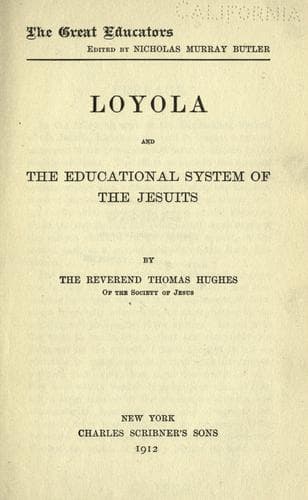
Loyola and the Educational System of the JesuitsHughes, Thomas
History
Loyola and the Educational System of the Jesuits
Hughes, Thomas
Education -- History; Ignatius, of Loyola, Saint, 1491-1556; Jesuits
1. There is one fundamental point, however, which should be touched
on, to meet a latent query in the mind. It refers to the kind of
education projected throughout. It is evidently not a special training
which is contemplated; not the training of specialists, or technical
students. All through the system, the field of pedagogical activity
is that of a general culture; and, therefore, properly an education.
The result aimed at is a general one, that of developing in the
young mind all fundamental qualities; of adjusting it, by the early
development of all natural fitnesses, to any special work of thought
and labor in the mature life of the future. It would lay a solid
substructure, in the whole mind and character, for any superstructure
of science, professional and special; also for the entire building
up of moral life, civil and religious. That such a general culture
should go before the special seems to be obvious. To supplant it by the
special, or even to abridge the process, is not only to sacrifice the
general culture; it has a more serious effect than that. By a false
economy, it cramps, curtails, and reduces to the smallest proportions
whatever possibilities existed of general and special qualifications
in the youthful mind. Without a broad, radical formation below,
the amplitude of organic growth above must necessarily fall short;
the roots underneath not having shot out, the development above is
wanting in vigor, to ramify according to its environment, and use its
opportunities. In a boy's mind, there is needed a suppleness of general
powers, as only the young mind can be made supple, while at the same
time it is preëminently apt to be general. It is what Seneca calls
_curiosum ingenium_, "an inquisitive genius," open to everything, and
prying to open everything. Memory is then at its flourishing stage,
ready to be cultivated throughout the extent of a potential vastness,
which will never again be experienced in life. If cultivated richly in
its season, it will be capable afterwards of every kind of ready yield,
according to its acquired tenacity, and according to the richness of
the seed deposited in it. The imagination, too, is at the stage of
impressionable and vital expansion, and is keenly sensitive to the
lights and shades of objective life. These are either brought under
its observation, or, better still, are pictured for it in beautiful
literature; since the fine fancy of great minds paints nature, as
nature herself is not found dressed at every one's door. The opening
judgment also is receptive of the thoughts and wisdom, which other
minds have thought out and handed down, encasing it, as they did so, in
a style worthy of their own vigor, and presenting it as the heritage
of the past to the present, of the wise old age of the world to its
youth, which may be wiser still. And thus in each individual youth, the
judgment being tenderly nursed, and learning ripening with age, what
Public-domain text, read in full here on John Shaqi.
Reviews
Reviews
No reviews yet
Be the first to share your thoughts on this work.
Elsewhere in the archive
Join the Discussion
Join the discussion
Sign in to leave a comment or review.
Sign InorCreate an account