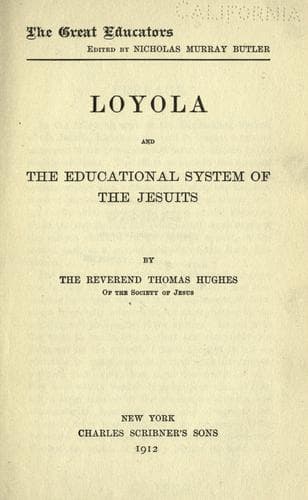
Loyola and the Educational System of the JesuitsHughes, Thomas
History
Loyola and the Educational System of the Jesuits
Hughes, Thomas
Education -- History; Ignatius, of Loyola, Saint, 1491-1556; Jesuits
was before in the memory passes gradually into the whole character and
competency of the man.
In the system which we are considering, the instrument employed for
working these effects is a literature in the hands of a competent
teacher; it is a great literature, and a double one. The great
literatures of Rome and Greece have always been considered adequate
instruments of universal culture. Under a literary aspect, the
eloquence and poetry of Greece had been the mistress of Roman
excellence. Under a philological aspect, the Latin tongue has been the
principal basis of our modern languages, as formed in the history of
Christendom. In both of them, the varied elements of richest thought
are brought into contact with the undeveloped, but developing nature of
the youth; glimpses of human life, individual, social, and political,
favor his inquiring eyes, and lead him to feel the finest springs of
human sentiment. Better still, he feels these springs as touched by the
greatest masters of expression; and he conceives thought as rendered
in a style worthy of the greatest thinkers; and that, in languages,
one of them the most delicately organized, the other perhaps the most
systematically elaborated, of all tongues living or extinct. And,
besides, these two literatures come down to us, bearing in their own
right what no other tongues can convey. Not as translations, which, in
their best form, exhibit only a respectable degree of mendicancy, and
represent other men's living thoughts in a decent misfit, these two
literatures come down to us bearing in their own right all the historic
memories of antiquity, as well sacred as profane; all the masterpieces
of eloquence and poetry, belonging to no less than two out of the very
few great epochs, those of Pericles and Augustus; all human philosophy,
from Socrates, Plato, and Aristotle, down to St. Thomas Aquinas, and,
further down, to Leibnitz and Newton, both of them men of classical
letters; in fine, all the traditions, the Faith, and Divinity of
Christendom.
Public-domain text, read in full here on John Shaqi.
Reviews
Reviews
No reviews yet
Be the first to share your thoughts on this work.
Elsewhere in the archive
Join the Discussion
Join the discussion
Sign in to leave a comment or review.
Sign InorCreate an account