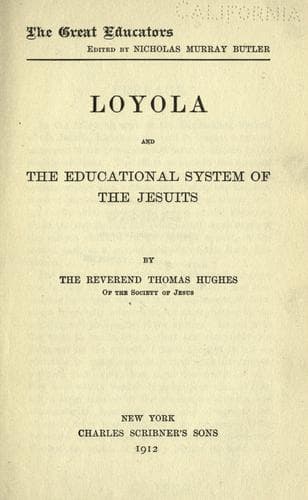
Loyola and the Educational System of the JesuitsHughes, Thomas
History
Loyola and the Educational System of the Jesuits
Hughes, Thomas
Education -- History; Ignatius, of Loyola, Saint, 1491-1556; Jesuits
1. All examinations, as projected by the _Ratio Studiorum_, are
conducted by word of mouth. Writing enters the examinations, only when
the written word itself is the subject of investigation. Thus, in the
grades of the literary course, the composition of the student, from
its elementary qualities of spelling, punctuation, grammar, up to
the most varied forms and species of style, comes under examination
for advancing to the next grade. But even then, after each of the
three examiners has inspected carefully the written composition, and
consulted the Master's reports of the individual's progress during the
year, they call in the writer, submit his paper to him, and subject him
to an oral investigation upon it. After that, they proceed to the other
branches, all by word of mouth.
In the higher courses, where style is no longer a matter of study,
writing never appears in examinations. Written dissertations, special
lectures, literary pieces of all kinds, composed for certain occasions,
are merely a part thenceforth of the exercises incident to those
courses.
To speak here only of Grammar and the Humanities, each new-comer, on
presentation of the credentials required, is examined by the Director
or Prefect of Studies, who "places him in the class, and with the
Professor, adapted to the boy's qualifications; in such a manner,
however, that the young person be rather worthy of the class above,
than unworthy of the class in which he is placed."[326] It is the
remark of the earlier critics, that "severity must be practised in
examinations, since it is more injurious for boys to ascend a grade,
when not fit, than, if really fit, to be kept where they are; and, in
addition to that, if they are advanced when not qualified, they create
no slight disturbance in the upper class."[327]
Into the lowest grade, neither youths advanced in age, nor boys of very
tender years, are to be admitted. The plea that parents merely want
the children to be in good hands is not a sufficient reason for taking
them; the only exception is for young boys who are really far advanced
for their years.
Public-domain text, read in full here on John Shaqi.
Reviews
Reviews
No reviews yet
Be the first to share your thoughts on this work.
Elsewhere in the archive
Join the Discussion
Join the discussion
Sign in to leave a comment or review.
Sign InorCreate an account