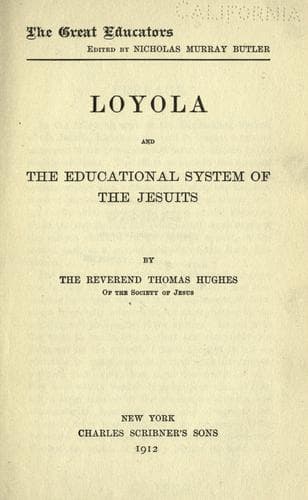
Loyola and the Educational System of the JesuitsHughes, Thomas
History
Loyola and the Educational System of the Jesuits
Hughes, Thomas
Education -- History; Ignatius, of Loyola, Saint, 1491-1556; Jesuits
These conditions of age, and sufficient preparation for entering the
classical course, illustrate very distinctly several features of the
policy which the Society pursued. Father Joseph Calasanzio, a priest
of great zeal, petitioned the Rector of the Roman College, which was
flourishing with more than two thousand students, to open some schools
for the unprovided children of Rome. There is a Latin word coined
from the first four letters of the alphabet, for designating this
elementary class of scholars, who are not yet qualified for literature.
The word is _abecedarii_. The term is employed both in the Constitution
of Loyola and in the _Ratio_. The Rector declined. Father Joseph
applied to the General Claudius Aquaviva. He too declined; he referred
to the Constitution of the Society, which had been distinctly and in
all its parts approved by the Popes. Unable to have his idea carried
out by the Jesuits, Father Joseph opened his first "Pious School" in
Rome, which was soon frequented by 1200 little boys, _abecedarii_.
After the founder's death in 1648, his work spread into the vast system
of _Scuole Pie_. In our times, the revised _Ratio_ of 1832 recognizes
the element of Preparatory Departments. It merely requires that they be
entirely under the same jurisdiction as the College proper.[328]
Another feature of the policy which these conditions illustrate and
which they also further, is that of their tending to discriminate
between the right kind of scholars and others, whose circumstances will
debar them from ever reaching the ultimate end of higher culture. Where
circumstances are not propitious, neither is the culture altogether
desirable. For what is more injurious to society at large than to have
young people hurt in two ways, positively and negatively; positively,
by placing them in a false environment of culture, which cannot be
theirs in future life; negatively, by taking up with such culture
all the time and labor which might usefully be spent in receiving a
plainer education, and reach its term in any commonest walk of life?
Besides, the liberal education itself suffers prejudice; for it is
misinterpreted; since it comes to be estimated then by results and by
circumstances which do not appertain to it. Every system should be set
on its own basis, and be built up subject to its own conditions. The
absoluteness of Loyola's Constitution throughout, and of the _Ratio
Studiorum_ in particular, throws this policy into relief at every turn.
Public-domain text, read in full here on John Shaqi.
Reviews
Reviews
No reviews yet
Be the first to share your thoughts on this work.
Elsewhere in the archive
Join the Discussion
Join the discussion
Sign in to leave a comment or review.
Sign InorCreate an account