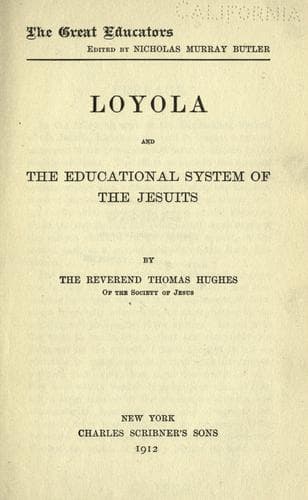
Loyola and the Educational System of the JesuitsHughes, Thomas
History
Loyola and the Educational System of the Jesuits
Hughes, Thomas
Education -- History; Ignatius, of Loyola, Saint, 1491-1556; Jesuits
After the boy's admission into a class, he advances thenceforward,
either with the whole class, at the general and solemn promotion every
year, or, if he excels, as the reports and the Master will determine,
he is not to be detained in that grade, but may ascend, at any time of
the year, after a fitting examination. A number of conditions, hard to
realize, make this special promotion barely possible from the grade of
First Grammar to Humanity, or from Humanity to Rhetoric.[329] On the
other hand, "if any one is found to be utterly incapable of entering
the next grade, no account is to be taken of any petitions."
2. In the philosophical and theological courses, both of which
terminate in the conferring of degrees, the system of examinations
for all students, who are not members of the Society, refers only to
those degrees, at the time when application is made for them. For the
philosophical degree, the first preliminary is an hour's disputation
with three examiners, on the matter of the whole course, and that
in presence of the other students. The result being satisfactory,
permission will then be granted to prepare for a public defence of
all Philosophy. This is the method for the solemn form of graduation,
which, in the old style, confers upon the successful student, after
three years of Natural Sciences, or Philosophy, the title of Master of
Arts.
At this point start the three professional lines of Medicine,
Jurisprudence, Theology. The last-named faculty ends in much the
same manner as that of Philosophy, but with a much greater amplitude
of public acts or defence, and then finally with a defence of all
Philosophy and Theology together. This entitles the defendant to the
degree of Doctor of Divinity, which is conferred in the most solemn
manner.
There is a pedagogical history connected with the present subject,
which it may be well to sketch in two stages, first, that of the
sixteenth century, and secondly, that of the nineteenth.
Ignatius of Loyola had legislated in his Constitution to this effect:
"In the study of Arts, courses shall be arranged in which the Natural
Sciences shall be taught; and, for these, less than three years will
not suffice; besides which, another half-year shall be assigned the
students, for repeating the matters they have heard, for holding public
acts of defence, and for receiving the degree of Master. The whole
course, therefore, shall be three years and a half, up to the reception
of the degree."[330] Again, Ignatius had legislated for Divinity: "The
course of Theology shall be six years in length; all the matters that
have to be read will be treated in the first four; in the other two,
besides making a repetition, those who are to be promoted to the degree
of Doctor will make the usual acts of defence."[331]
Public-domain text, read in full here on John Shaqi.
Reviews
Reviews
No reviews yet
Be the first to share your thoughts on this work.
Elsewhere in the archive
Join the Discussion
Join the discussion
Sign in to leave a comment or review.
Sign InorCreate an account