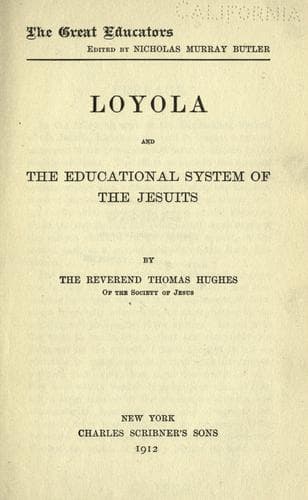
Loyola and the Educational System of the JesuitsHughes, Thomas
History
Loyola and the Educational System of the Jesuits
Hughes, Thomas
Education -- History; Ignatius, of Loyola, Saint, 1491-1556; Jesuits
He has now had experience of prisons and chains, on the charge of
teaching error, or of being a dangerous enthusiast. One of the calmest
and coolest of men, who never acted, but he first calculated, and who
never allowed himself to approach a conclusion, without first freeing
himself from all bias and impulse, he had suffered repeated arrest
for setting people beside themselves, for moving them to give up all
they had in behalf of piety, or charity, and inducing them to go and
live on alms themselves; nay, perhaps throw in their lives, talents
and acquirements, to serve others gratis. The founder of the Jesuits,
himself the first of an Order which has the reputation of being the
staunchest upholder, as well of authority in every rank of society,
as of the truths taught by the Catholic Church, was put in chains,
or arraigned by the ecclesiastical authorities almost wherever he
appeared, though always acquitted as blameless.
In a letter written at a subsequent period of his life to King John
III of Portugal, Ignatius sums up his experiences, as including two
imprisonments, at Alcalà and Salamanca; three judicial investigations,
at Alcalà, Salamanca, and Paris; later on, another process at Paris;
then one at Venice; finally another at Rome;--eight investigations
about this one man in Spain, France, and Italy.[10] Wherever he came,
in after life, it passed as a proverb among the Fathers, that his
appearance was the sure harbinger of a storm, soon to break out against
them somewhere, in the social or religious world. He braved all this
fury in his own manner, weighing as deliberately every word he spoke,
and measuring every step he took, as when he had stood in the breach
of the ramparts at Pampeluna. But his personal experience made him
commit to the sacred keeping of the "Spiritual Exercises" an important
principle of liberal and humane prudence. It is couched in the first
words of his little book, to guide teacher and learner alike. He says:--
"In the first place, it is to be supposed that every pious Christian
man should be more ready to interpret any obscure proposition of
another in a good rather than a bad sense. If, however, he cannot
defend the proposition in any way, let him inquire of the speaker
himself; and, if then the speaker is found to be mistaken in sentiment
or understanding, let him correct the same kindly. If this is not
enough, let him employ all available means to render him sound in
principle and secure from error."
Public-domain text, read in full here on John Shaqi.
Reviews
Reviews
No reviews yet
Be the first to share your thoughts on this work.
Join the Discussion
Join the discussion
Sign in to leave a comment or review.
Sign InorCreate an account