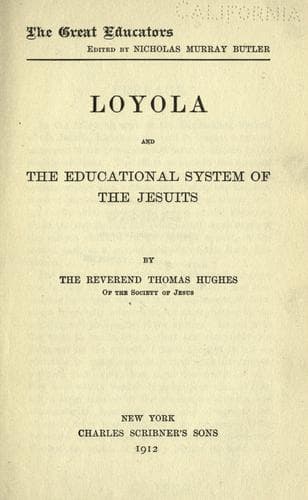
Loyola and the Educational System of the JesuitsHughes, Thomas
History
Loyola and the Educational System of the Jesuits
Hughes, Thomas
Education -- History; Ignatius, of Loyola, Saint, 1491-1556; Jesuits
How far the personal experiences of its founder attached by a law of
heritage to his Order, I can hardly undertake to describe. But, just
for the sake of completing the family picture, I will mention the heads
of a doleful list, which an historian of the Society catalogues. He
enumerates, as objects of attack and misrepresentation, the founder
himself, the name of the Society of Jesus, the dress, rules, manners,
books, doctrine, schools, sermons; the poverty, obedience, gratuitous
service of the Jesuits; that they affected a kind of literary empire,
under the spur of an intolerable ambition; that they were lightly
tinctured, and had just sipped of many things, of which they had
nothing solid to offer; yes, that they wanted to have it believed there
was no sanctuary of the Muses, no shrine of sacred or human wisdom in
existence, outside of their own colleges; that, from these offices of
theirs, all arts and sciences came forth, done up in the best style.
"In fine, whatever they do or don't do, granted that there are many
false charges which their enemies concoct against them,--things too
extreme to be believed,--granted that they are acquitted of many vices
laid to their account, never certainly will they escape the suspicion,
at least, which these charges excite."[11] We believe it. There is a
good homely English proverb which expresses the very same idea--about
the happy adhesiveness of a clayey compound when cleverly thrown.
This retrospect of history was taken, exactly one hundred years after
the foundation of the Order. The story had begun some thirteen years
before it was founded. When Ignatius became a responsible leader with
associates, he had recourse more than once to the process of justice,
to clear his reputation in full form. But, beyond the cases which
rendered such defence prudent and necessary, his practical policy was
expressed in a practical maxim, which after him his successor, James
Laynez, had often in his mouth: _Deus faxit ne unquam male loquantur et
vera dicant!_ "God grant they never talk ill of me and be saying the
truth!" Indeed, as there is no use in trying to change men, for they
will never be born anew, Ignatius looked rather in another direction
for the solution of difficulties; expecting that troubles, which defied
other treatment, might still not survive their authors. Speaking of
a powerful adversary, who was raising a great storm at Toledo and
Alcalà, and whom it took the royal council and then a brief from the
Pope to quell, Ignatius said of him to Ribadeneira: "He is old, the
Society is young; naturally the Society will live longer than he will."
The same dignitary, suppressed though he was, rose again in violent
opposition. Whereupon Jouvancy makes the apt remark: "So difficult is
it for even the most eminent men, and so rare a thing, when once they
have conceived a notion, to get it out of their heads again!"[12] No,
men are not born anew.
Public-domain text, read in full here on John Shaqi.
Reviews
Reviews
No reviews yet
Be the first to share your thoughts on this work.
Join the Discussion
Join the discussion
Sign in to leave a comment or review.
Sign InorCreate an account