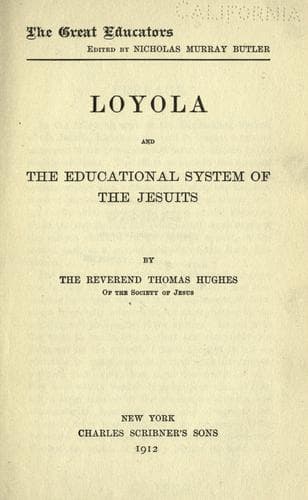
Loyola and the Educational System of the Jesuits — John Shaqi
Loyola and the Educational System of the JesuitsHughes, Thomas
History
Loyola and the Educational System of the Jesuits
Hughes, Thomas
Education -- History; Ignatius, of Loyola, Saint, 1491-1556; Jesuits
As defined by Jesuit authors, the education of youth means the
gratuitous teaching of Letters and Science, from almost the first
beginnings of Grammar up to the culminating science of Sacred Theology,
and that for boys and students of every kind, in schools open to
all.[21] Evidently these university men, who were engaged in drawing
up the Institute, considered that, if the greatest Professor's talents
are well spent in the exposition of the gravest doctrines in Theology,
Philosophy, and Science, neither he, nor any one else, is too great
to be a schoolmaster, a tutor, and a father, to the boy passing from
childhood on to the state of manhood,--that boyhood which, as Clement
of Alexandria says, furnishes the very milk of age, and from which the
constitution of the man receives its temper and complexion.
It is requisite here to observe, that there was no such thing in
existence, as State Education. Two reasons may briefly be mentioned for
this, one of them intrinsic to the question, the other an historical
fact. The intrinsic and essential reason was the sacred character of
education, as being an original function, belonging to the primary
relations of parents and child. States, or organized commonwealths,
come only in the third or fourth degree of human society. It was much
later, in that short interval between the extinction of the Society
of Jesus and the outburst of the French Revolution, that new theories
came to be proclaimed, as La Chalotais did openly proclaim them, of
a bald and blank deism in social life, and therefore of secularizing
education. Between deism and secularization the connection was
reasonable. For, if the rights of God went by the board, there was no
reason why the rights of parents and children should remain. All alike,
the persons and "souls of men,"[22] fell back into the condition in
which Christianity had found them; they became chattels of the state,
mannikins of a bureau in peace, "food for powder" in war.
The other reason was an historical fact. For all the purposes of
charity, mercy, and philanthropy, there were powers in existence,
as part of the normal religious life of general Christian society.
They were the same powers that had made Christendom, and had carried
it on so far as the Christian world, the same to which we owe the
civilization of to-day. More than that. As there is not a single work
of charity or mercy, say St. Thomas Aquinas, which may not be made the
object of an institution, religious men or women devoting their lives
as a service to God, in a special service towards their neighbors;
so, in point of fact, there were very few such objects which had not
originated some service of religious self-consecration in their behalf.
Public-domain text, read in full here on John Shaqi.
Reviews
Reviews
No reviews yet
Be the first to share your thoughts on this work.
Join the Discussion
Join the discussion
Sign in to leave a comment or review.
Sign InorCreate an account