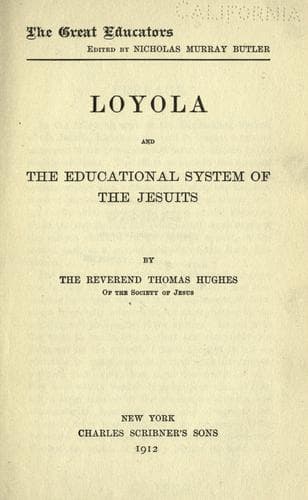
Loyola and the Educational System of the JesuitsHughes, Thomas
History
Loyola and the Educational System of the Jesuits
Hughes, Thomas
Education -- History; Ignatius, of Loyola, Saint, 1491-1556; Jesuits
Teaching Christian doctrine pertains to the duty of those who have
the ordinary care of souls. No duty of this kind, as belonging to
the ordinary sphere of the Church's clergy, would Ignatius assume
as characteristic of his own Institute, except this one. He was,
indeed, more than ready to throw in his contribution of personal zeal
and charity, for the furtherance of all kinds of benevolence and
beneficence. Personally, at the cost of untiring activity, he sowed,
as Genelli well observes, the first seeds of those ameliorations in
social life, and of those humane institutions, which are so marked a
feature of later ages.[17] He was an original benefactor of humanity
at the turning-point of modern history, which has since become an era
of social organized beneficence. Urban VIII solemnly testifies, that
Ignatius organized homes for orphans, for catechumens, for unprovided
women; that the poor and the sick, that children and the ignorant and
prisoners, were all objects of his personal solicitude.[18] These works
of zeal and charity became, in subsequent years, the specific reasons
of existence for various other communities, which rose in order and in
number. But he did not adopt them as specific in his Institute; nor
did he assume as characteristic anything within the province of the
ordinary parochial clergy, except the teaching of Christian doctrine
to boys and uncultured persons. The rest he attended to, while not
provided for; ready to drop them, when provision should be made for
them.
But he did assume five works, which were outside of the ordinary
lines; and, among them, is the subject of our study, the Education of
Youth.[19] As the selection of all these specialties for his Institute
reveal the commander's eye resting on a field, where many issues were
being fought out, so, in particular, his selection of education as a
specialty betrayed the same masterly thought, in the institutions he
projected, in the scope he proposed, and, above all, in the formation
of his teachers.
There had been, among the Fathers deliberating, a difference of
opinion, with respect to Christian doctrine. Bobadilla had dissented
from making that work the subject of a special vow; and the others
deferred to him. But there was unanimity with regard to every other
topic of deliberation, including this one, "the education of youth,
having colleges in universities."[20]
Public-domain text, read in full here on John Shaqi.
Reviews
Reviews
No reviews yet
Be the first to share your thoughts on this work.
Join the Discussion
Join the discussion
Sign in to leave a comment or review.
Sign InorCreate an account