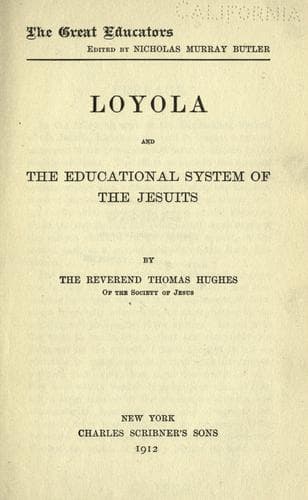
Loyola and the Educational System of the JesuitsHughes, Thomas
History
Loyola and the Educational System of the Jesuits
Hughes, Thomas
Education -- History; Ignatius, of Loyola, Saint, 1491-1556; Jesuits
For fear that, in the execution of this plan, and in their other
enterprises of devotion and zeal, any secondary intentions or results,
with regard to power and office, might mar the purity of the work
and defeat the main object, the same men, whose future under the
generalship of such a leader was about to open as one of transcendent
influence in the civilized world, bound themselves by vow never to
accept any dignity or office in the Church. Naturally they should keep
aloof from affairs of state. In fact, it would be incompatible with
their own purposes of literary and scientific competence, to leave
themselves at the mercy of other men's views, and be drafted into posts
outside of the Institute, and be placed in an impossible situation for
working out the specific end intended. It would be suicidal too. Just
when a man was capable of continuing his kind, he would be lost to the
body, and be rendered incapable thereby of propagating his own type
of eminence. Besides, without touching upon the inner reasons of the
spiritual life, which made this resignation of all honors desirable,
it is a fact standing out in clear relief, as history sketches the
marvellous fecundity of an Order requiring such a high level of
attainments, that many of the choicest souls have felt specially
attracted to a kind of life, which at one and the same time satisfied
their ideas of Christian perfection, and cut them off from all the
paths of worldly glory.
And now, to mention in the last place another point, which is equally
important for understanding the educational history of the Order, and
to the general mind is equally obscure with some of those mentioned
already, there was introduced the principle of religious obedience. It
was sanctioned by a unanimous vote.[25] The Fathers had concluded the
first deliberation, whether they should form a society at all; and
they had decided in the affirmative sense.[26] Then the question took
this phase. If they were to found a closely-knitted society, they could
do so only by assuming a strict bond. That was none other than a strict
obedience.
On this head, as on all others that came in order, they began the
deliberation by reasoning, one day, in an adverse sense, all having
prepared their minds to emphasize every objection which they could find
against it. The day following, they argued in a positive sense. The
motives in favor of strict obedience won their unanimous assent. They
were such as these:--
Public-domain text, read in full here on John Shaqi.
Reviews
Reviews
No reviews yet
Be the first to share your thoughts on this work.
Join the Discussion
Join the discussion
Sign in to leave a comment or review.
Sign InorCreate an account