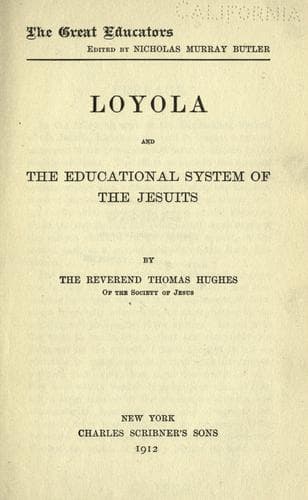
Loyola and the Educational System of the JesuitsHughes, Thomas
History
Loyola and the Educational System of the Jesuits
Hughes, Thomas
Education -- History; Ignatius, of Loyola, Saint, 1491-1556; Jesuits
If this congregation undertook the charge of affairs, and the members
were not under orders, no one could be held responsible for an exact
administration of the charge. If the body were not bound together
by obedience, it could not long persevere; yet this was their first
intention, to remain associated in a permanent body. Whence they
concluded that scattered as they would be, and already had been, in
assiduous and diverse labors, they must be united by a strict principle
of subordination, if they were to remain such a body. Another argued
thus: Obedience begets heroism of virtue; since the truly obedient
man is most prompt to execute whatever duty is assigned him by one,
whom, as by a religious act, he regards as being in the place of God,
and signifying to him God's will: wherefore obedience and heroism go
together.
This reasoning seems to be enforced by the history of all great
nations, in the crises of their military and other public affairs. But,
as is clear, the principles of religious obedience are of a different
order; they are on a higher plane; and they reach much farther in time
and eternity, than those of obedience elsewhere.
Here then we discern, sufficiently for present purposes, the meaning
and historical location of this Institute. The members have cut
themselves off from the possession of all private property, by the
voluntary engagement to poverty, and thereby they have prepared the
endowment, on which education will chiefly rest,--that is to say, the
endowment consisting of the men to teach, and their services tendered
gratis. Position and dignity are alike rendered inaccessible by an
express vow of the members professed. Obedience keeps the organization
mobile as a company of trained soldiers. And, if any observant mind,
well acquainted with the course of human affairs, detects in these
principles some reasons for success, normal, habitual, and regular,
in the face of unnumbered obstacles, and of unremitting hostility,
his view will be singularly corroborated when he rises to a plane
higher, and regards the same principles as "religious," carrying with
them the sanction of divine worship; which I should be loath to call
"enthusiasm," much less "fanaticism." These sentiments are never very
prudent, nor enlightened, nor cool; they are either very natural or
are short-lived. A mild fever of fanaticism can scarcely produce
high results; and a high fever of the same can scarcely last three
hundred and fifty years, with perpetuity still threatening. But I
would call this phenomenon, in its origin, religious devotion; in its
consequences, a supernatural efficiency; and, taking it all in all,
that which is called a grace of vocation.
Public-domain text, read in full here on John Shaqi.
Reviews
Reviews
No reviews yet
Be the first to share your thoughts on this work.
Join the Discussion
Join the discussion
Sign in to leave a comment or review.
Sign InorCreate an account