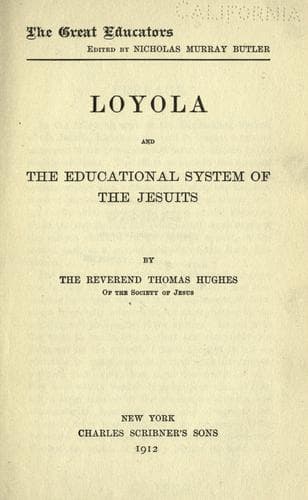
Loyola and the Educational System of the Jesuits — John Shaqi
Loyola and the Educational System of the JesuitsHughes, Thomas
History
Loyola and the Educational System of the Jesuits
Hughes, Thomas
Education -- History; Ignatius, of Loyola, Saint, 1491-1556; Jesuits
A learned and elegant work, which narrates the rise and progress of
Christian Schools, from the sixtieth year of the Christian era onwards,
ends its long journey at the date of the Reformation, and takes leave
of its varied subject, and of its lines of Christian Scholars, in these
words: "We leave them at the moment when the episcopacy was recovering
its ancient jurisdiction over the ecclesiastical seminaries, and when
a vast majority of the secular schools of Catholic Christendom were
passing into the hands of a great Religious Order, raised up, as it
would seem, with the special design of consolidating anew a system of
Christian education."[1]
Two centuries and a half later, when the Society of Jesus had run a
long course, from the date of the Reformation which had seen it rise,
up to the eve of the Revolution which beheld it extinct, a General of
the Order, Ignatius Visconti, addressing the Provincial Superiors over
the world, takes note of a new stage in the process of educational
development: "The taste for letters now," he says, "is more keen and
exquisite, and the number of literary schools has increased so much,
that ours may no longer appear so necessary. For I may mention the fact
that, besides our schools of polite letters, there were, for a long
while, either none or very few. So that parents were forced to send
their children to us, even if otherwise they did not want it."[2]
This refers in a quiet way to what Leopold von Ranke states with more
emphasis. Speaking of Grammar classes, the German historian says: "Here
also the Jesuits succeeded to admiration. It was found that young
people gained more with them in six months, than with other teachers
in two years. Even Protestants removed their children from distant
gymnasia to confide them to the care of the Jesuits."[3] Ranke narrates
in the same place how it was "toward the universities above all that
the efforts of the Jesuits were directed." And he describes what the
results were in Germany.
D'Alembert writes of their progress in France: "Hardly had the Company
of Jesus begun to show itself in France, than it met with difficulties
without number, in the endeavor to establish itself. The universities
especially made the greatest efforts to keep the new-comers out. It
is difficult to decide whether this opposition is a praise or a
condemnation of the Jesuits who stood it. They announced gratuitous
teaching; they counted among their number celebrated and learned men,
superior perhaps to those whom the universities could boast of," etc.[4]
Public-domain text, read in full here on John Shaqi.
Reviews
Reviews
No reviews yet
Be the first to share your thoughts on this work.
Join the Discussion
Join the discussion
Sign in to leave a comment or review.
Sign InorCreate an account