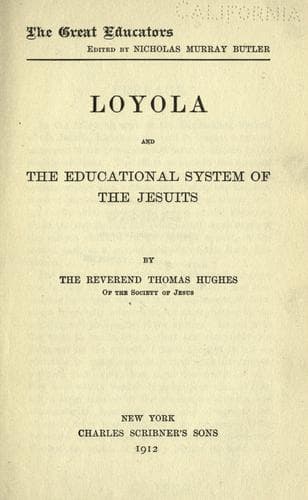
Loyola and the Educational System of the JesuitsHughes, Thomas
History
Loyola and the Educational System of the Jesuits
Hughes, Thomas
Education -- History; Ignatius, of Loyola, Saint, 1491-1556; Jesuits
Speaking of the Protestants in the Netherlands, a chronicle, which
reviews the first century of the Order's existence, records that "the
Jesuit schools were expressly interdicted, under severe penalties,
to all members of the Protestant communities. Even in a twelve-year
truce which the Order partially enjoyed, a monthly fine of one hundred
florins was still imposed upon all delinquents, or on their parents,
who persisted in patronizing the Jesuit schools. To escape the fine,
parents sent their children under an assumed name.[5]
In every country, the same drama of struggle and contest evolved itself
through two and a half centuries, till a momentous scene was witnessed.
It was a scene of such a kind as seldom has occurred in history; and
never certainly was any similar event thrown into such relief by the
sequel. The event which I refer to was a universal and instantaneous
suppression of the Order; with consequences following thereupon which
were exceptional, both in the world that witnessed it, and in the
subject-body that suffered it.
The sequel in the world at large was that, a few years later, at the
close of the eighteenth century, there broke out the great Revolution
under the leadership of men, of whom scarcely one had been more than
seven years of age at the date of the Jesuits' expulsion.[6] They
represented in France the first generation which had not been educated
by the Society. The remote causes which overwhelmed the Order were
the same that ushered in the Revolution. But, among the immediate
causes, assigned by historians to account for the precise form which
the great convulsion assumed, and for the date at which it occurred,
is placed the dissolution of this Order. According to the Count de
Maistre, who speaks of the political sentiment of his own times, all
observers agreed that the revolution of Europe, still called the
French Revolution, was impossible without the preliminary destruction
of the Jesuits. And, in keeping with this, it was equally a subject
of observation, as being a palpable historical fact, that during two
centuries the Jesuits had formed in their College at Paris, the élite
of the French nobility; and that, only a few years after the expulsion
of the Jesuit Masters, the same college turned out the Robespierres,
Camille Desmoulins, Tallien, Noël, Fréron, Chénier, and other such
demagogues. This College of Clermont, or Louis-le-Grand, from which the
Jesuits were expelled in 1762, had been immediately occupied by the
University of Paris. The Revolution broke out twenty-seven years later.
Public-domain text, read in full here on John Shaqi.
Reviews
Reviews
No reviews yet
Be the first to share your thoughts on this work.
Join the Discussion
Join the discussion
Sign in to leave a comment or review.
Sign InorCreate an account