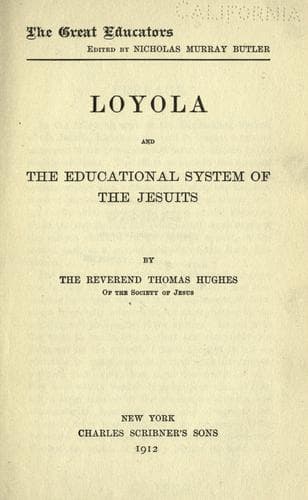
Loyola and the Educational System of the JesuitsHughes, Thomas
History
Loyola and the Educational System of the Jesuits
Hughes, Thomas
Education -- History; Ignatius, of Loyola, Saint, 1491-1556; Jesuits
On the 27th day of September, 1540, the Society of Jesus received
from the See of Rome its bull of confirmation, by which it became a
chartered body of the Church. While these pages were being penned, the
27th day of September came by, 1890. It was the anniversary of that
foundation, three hundred and fifty years ago.
CHAPTER IV.
COLLEGES AS PROPOSED IN THE JESUIT CONSTITUTION.
The written rule about the system of education is found in a double
stage of development. The first is that in which Loyola left it: it
gives us the outline. The second is that in which Aquaviva completed
it: this presents us with the finished picture. Likewise in the
historical course of administration out in the world, the development
is twofold. It runs its first course from Loyola to Aquaviva, while
experience was still tentative. Its second course was subsequent to
Aquaviva, when experience, having gathered in its results, had only
to apply the approved form. This was subject thenceforth to none
but incidental changes, as times and places change. And, for these
contingencies, the application remained expressly and always pliable.
Hence, whatever was embodied in the _Ratio Studiorum_, as completed,
had been the result of the most varied experience before legislating,
an experience in the life of the Order extending over fifty-nine years.
Whatever this universal experience had not yielded as a positive
result, or as applicable to all places, was not embodied. Teachers
are different; national customs vary; vernacular tongues are not the
same. With regard to these mutable elements, the maxim of the Order
in studies, in teaching, in conducting colleges, was the same as that
which it proposed to itself in the various other functions of practical
life. An exponent of the Institute states the maxim thus: "One should
have a most exact knowledge of the country, nation, city, manner of
government, manners of the people, states of life, inclinations,
etc.; and this from histories, from intercourse, etc."[27] General
indications alone are given with regard to these variable factors. The
same is done with respect to new sciences, which from the time of the
Renaissance were felt to be approaching and developing. Subsequent
legislation arises to meet them as they come.
While the Fathers were carrying on the same deliberations to which I
referred in the preceding chapter, a resolution was taken to leave the
drafting of a Constitution in the hands of those who should remain in
Italy. Circumscribing the task still more, they decided to appoint
a committee of two, who should address themselves to this work, and
report to the rest. The general assembly when convened would issue the
final decree. Whatever that should be, such of those present as might
then be absent hereby endorsed it beforehand.
Public-domain text, read in full here on John Shaqi.
Reviews
Reviews
No reviews yet
Be the first to share your thoughts on this work.
Join the Discussion
Join the discussion
Sign in to leave a comment or review.
Sign InorCreate an account