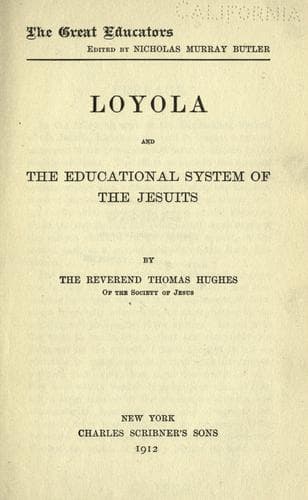
Loyola and the Educational System of the JesuitsHughes, Thomas
History
Loyola and the Educational System of the Jesuits
Hughes, Thomas
Education -- History; Ignatius, of Loyola, Saint, 1491-1556; Jesuits
Two years later, representatives from the twelve provinces of the
Order met together, and elected James Laynez as successor to Father
Ignatius. Examining once more this Constitution in all its parts,
receiving the whole of it just as it stood with absolute unanimity,
and with a degree of veneration, they exercised the supreme authority
of the Order, and confirmed this as the written Constitution of the
Society of Jesus. By this act nothing was wanting to it, even from the
side of Papal authority. Yet, that every plenitude of solemnity might
be added to it, they presented it to the Sovereign Pontiff, Paul IV,
who committed the code to four Cardinals for accurate revision. The
commission returned it, without having altered a word, From that time,
whatever general legislation has been added, has entered into the
_corpus juris_, or "Institute" at large, as supplementing or explaining
the "Constitution," which remains the fundamental instrument of the
Institute.
In the Constitution there are ten parts. The fourth is on studies.
In length, this fourth part alone fills up some twenty-eight out of
one hundred and eleven quarto pages in all, as it stands printed in
the latest Roman edition. The legislation about studies is thus seen
to be one-fourth of the whole. It has seventeen chapters. In one of
them, on the Method and Order to be observed in treating the Sciences,
the founder observes that a number of points "will be treated of
separately, in some document approved by the General Superior." This
is the express warrant, contained in the Constitution, for the future
_Ratio Studiorum_, or System of Studies in the Society of Jesus. In
the meantime, he legislates in a more general way. And he begins with
a subject pre-eminently dear to him, the duty of gratitude. Since
corporations are notoriously forgetful, and therefore ungrateful, he
lays down in the first place the permanent duty of the Order towards
benefactors: then he continues with other topics. They stand thus:--
The Founders of Colleges; and Benefactors. The Temporalities of
Colleges. The Students or Scholastics, belonging to the Society.
The Care to be taken of them, during the time of their Studies. The
Learning they are to acquire. The Assistance to be rendered them
in various ways, to ensure their success in studies. The Schools
attached to the Colleges of the Society, i.e. for external Students
not belonging to the Order. The Advancement of Scholastics, belonging
to the Order, in the Various Arts which can make them useful to their
Neighbor. The Withdrawal of them from Studies. The Government of
Colleges. On Admitting the Control of Universities into the Society.
The Sciences to be taught in Universities of the Society. The Method
and Order to be observed in treating the foregoing Sciences. The Books
to be selected as Standards. Courses and Degrees. What concerns Good
Morals. The Officials and Assistants in Universities.
Public-domain text, read in full here on John Shaqi.
Reviews
Reviews
No reviews yet
Be the first to share your thoughts on this work.
Join the Discussion
Join the discussion
Sign in to leave a comment or review.
Sign InorCreate an account