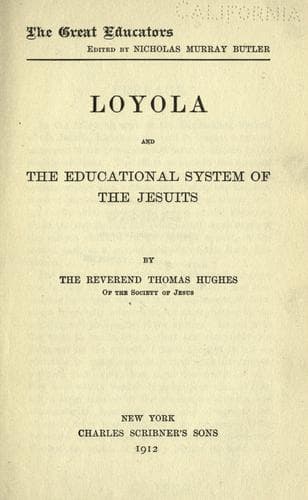
Loyola and the Educational System of the Jesuits — John Shaqi
Loyola and the Educational System of the JesuitsHughes, Thomas
History
Loyola and the Educational System of the Jesuits
Hughes, Thomas
Education -- History; Ignatius, of Loyola, Saint, 1491-1556; Jesuits
Reserving the pedagogic explanation for the next part of this essay, I
shall here sketch some of the more general ideas running through the
whole legislation of Ignatius of Loyola; and, first, in the present
chapter, I shall begin with his idea of Colleges.
Choosing personal poverty as the basis on which to rest this vast
enterprise of education, he did not therefore mean to carry on
expensive works of zeal, without the means of meeting the expense.
Obviously, it is one thing not to have means, as a personal property,
and therefore not to consume them on self; it is quite another, to have
them and to use them for the good of others. The most self-denying men
can use funds for the benefit of others; and can do so the better, the
more they deny themselves. It was in this sense that, later on in the
century, Cardinal Allen recognized the labors and needs of the English
Jesuit, Robert Parsons, who was the superior and companion of Edmund
Campian, the former a leading star of Oxford, the latter, also an
Oxford man, and, as Lord Burghley called him, "a diamond" of England.
Since Queen Elizabeth was not benign enough to lend the Jesuits a
little building-room on English soil, but preferred to lend them a
halter at Tyburn, Parsons was engaged in founding English houses of
higher studies in France and Spain, at Valladolid, Seville, Lisbon, Eu,
and St. Omer. Cardinal Allen sent a contribution to the constructive
Jesuit, writing, as he did so: "Apostolic men should not only despise
money; they should also have it." And just in this sense was Ignatius
himself a philosopher of no utopian school. So we may examine, with
profit, the material and temporal conditions required in his Institute,
for the establishment of public schools and universities. I shall
endeavor to put these principles together and in order.[29]
First, there should be a location provided with buildings and revenues,
not merely sufficient for the present, but having reference to needful
development.
Secondly, these material conditions include a reference to the
maintenance of the faculty. The means must be provided to meet the
daily necessities of the actual Professors, with adequate assistance of
lay brothers belonging to the Order; also to support several substitute
Professors; besides, to carry on the formation of men, who will take
the places of the present Professors, and so maintain the faculty as
perpetual; moreover, to "provide for some more Scholastic Students of
the Order, seeing that there are so many occupied in the service and
promotion of the common weal." These conditions also include "a church
for conducting spiritual ministrations in the service of others."[30]
Public-domain text, read in full here on John Shaqi.
Reviews
Reviews
No reviews yet
Be the first to share your thoughts on this work.
Join the Discussion
Join the discussion
Sign in to leave a comment or review.
Sign InorCreate an account