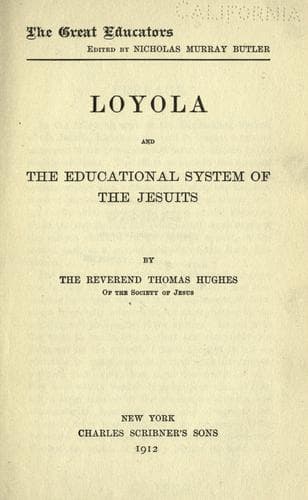
Loyola and the Educational System of the Jesuits — John Shaqi
Loyola and the Educational System of the JesuitsHughes, Thomas
History
Loyola and the Educational System of the Jesuits
Hughes, Thomas
Education -- History; Ignatius, of Loyola, Saint, 1491-1556; Jesuits
This was the more obviously his idea, as we find him reluctantly
granting permission for ministerial excursions through a country, if
thereby the Fathers' influence in a great city be likely to suffer.
He writes to Father Kessel, the Rector at Cologne, where as yet the
Society had no college of its own, that "under the circumstances he
approves of Kessel's making a short excursion through the province,
provided he and his companions are not long absent from the city, and
do not sacrifice the main thing to what is accessory; but he does not
give them permission to fix their abode out of the town, because places
of less importance afford fewer occasions of gathering the desired
fruit: and, besides, they must not leave so famous a university; their
exertions will be more useful for the good of religion, in forming
scholars to become priests and officers of the State, than all the
pains they may bestow on the small towns and villages."[33] Again,
when in 1547 he had accepted the donation of a church, buildings, and
gardens at Tivoli from Louis Mendosa, he found the place not suited
to the convenience of scholars; it was too near Rome, and yet too
far; subsequently, the institution had to be transferred within the
city."[34]
Fourthly, in addition to these material and local conditions for the
normal conduct of colleges, it is supposed that the external relations
of political society are so far favorable, as at least to tolerate
freedom of action on the part of this educational Institute. Such
toleration was, as a general rule, not only the least that could be
asked for, but the most that was enjoyed.
These are the chief conditions, material and temporal, which Ignatius
requires. They give him a footing to commence his work, and allow the
animating principles of his Institute to come into play. The animating
principles, to which I refer, may be reduced to three brief heads:
First, an intellectual and moral scope, clearly defined, as I shall
explain in the following chapters. Secondly, the distinct intention
to promote rather the interests of public and universal order and
enlightenment, than a mere local good of any city, country, province.
Thirdly, a tendency in the intellectual institution itself to become
rather a great one than a small one, with more degrees of instruction,
more and more eminent Professors, a greater number of the right kind of
scholars.[35]
Public-domain text, read in full here on John Shaqi.
Reviews
Reviews
No reviews yet
Be the first to share your thoughts on this work.
Join the Discussion
Join the discussion
Sign in to leave a comment or review.
Sign InorCreate an account