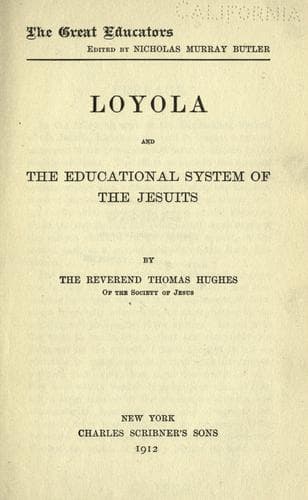
Loyola and the Educational System of the JesuitsHughes, Thomas
History
Loyola and the Educational System of the Jesuits
Hughes, Thomas
Education -- History; Ignatius, of Loyola, Saint, 1491-1556; Jesuits
As to the forces available for all this, and the proportion of colleges
to be manned in perpetuity, the mind of Ignatius was most express,
and became more fixed from day to day. "Cut your cloak according to
your cloth," he said to Oliver Manare, when the latter, on going to
establish a college at Loretto, asked how he should distribute his
men. Ignatius preferred to refuse Princes and Bishops their requests,
excusing himself on the score of limited resources, than compromise the
reputation of the Society, by an ill-advised assent.[36] And he said,
as Polanco his secretary tells us, that "if anything ought to make him
wish to live a longer time, it was that he might be severe in admitting
men into the Order."[37] He did not want to have many members in the
Society; still less, too many engagements.
Having stated thus briefly the material conditions required by
Ignatius, and the animating principles or motives which determined
him, we are in a position to discern more distinctly the central
object of his attention, that for which the material conditions were
provided, that by which the ultimate objects were to be attained. It
was the teaching body, the faculty, the "College," properly so called.
The "College" was the body of educators who were sent to a place.
For them the material conditions did but supply a local habitation,
subsistence, books, apparatus. The very first decree quoted by
Pachtler, from the first general assembly, uses the term "College" in
this sense: "No college is to be _sent_ to any place," etc.[38]
It is only by derivation from this meaning that the term is applied to
the buildings and appointments. It is the body of men that makes the
institution. It is this also which makes the institution perpetual;
and therefore must itself be so; and must have the material conditions
provided for continuing itself, by means of a constant stream of
younger men under formation, who will perpetuate the same work.
Public-domain text, read in full here on John Shaqi.
Reviews
Reviews
No reviews yet
Be the first to share your thoughts on this work.
Join the Discussion
Join the discussion
Sign in to leave a comment or review.
Sign InorCreate an account