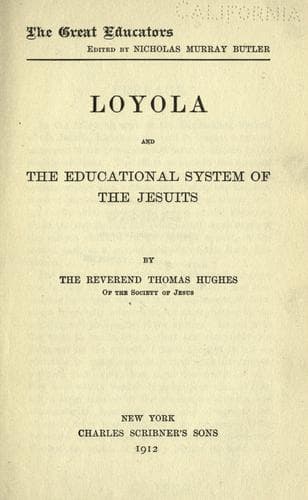
Loyola and the Educational System of the Jesuits — John Shaqi
Loyola and the Educational System of the JesuitsHughes, Thomas
History
Loyola and the Educational System of the Jesuits
Hughes, Thomas
Education -- History; Ignatius, of Loyola, Saint, 1491-1556; Jesuits
This man, who had inserted in the authentic formula and charter of his
Institute that watchword of his movements, "Defence and Advance"; who
had taken the whole world for the field of his operations, in defending
and advancing; this cavalier of a new military type, who had only to
show himself upon the field to gather around him the flower of youth as
well as mature age, from college and university, from doctor's chair
and prince's throne, left behind him, as the work of fifteen years from
the foundation of the Order, about one hundred colleges and houses,
distributed into twelve Provinces. The territorial divisions were
named, after their chief centres, the Provinces of Portugal, Castile,
Andalusia, Aragon, Italy, Naples, Sicily, Upper Germany, Lower Germany,
France, Brazil, and the East Indies. Individuals under his orders had
overrun Ireland, penetrated into Scotland, into Congo, Abyssinia, and
Ethiopia. The East Indies, first traversed by Francis Xavier either
on foot, or in unseaworthy vessels, signified the whole stretch of
countries from Goa and Ceylon on the West, to Malacca, Japan, and the
coast of China on the East. Some of this activity might be credited to
apostolic zeal alone, were it not that, wherever the leaders advanced
into the heart of a new country, it was always with the purpose, and
generally with the result, that the country was to be occupied with
educational institutions. De Backer notes this in another connection,
when, in the preface to his great work of bibliography, "The Library
of Writers of the Company of Jesus," he says: "Wherever a Jesuit set
his foot, wherever there was founded a house, a college, a mission,
there too arose apostles of another class, who labored, who taught, who
wrote."[45]
What this means, with regard to its strategic value, there is no need
of our being told. The Duke of Parma, writing, in 1580, from the seat
of war in the Netherlands to Philip II of Spain, said: "Your Majesty
desired that I should build a citadel in Maestricht; I thought that a
college of the Jesuits would be a fortress more likely to protect the
inhabitants against the enemies of the Altar and the Throne. I have
built it."[46]
Sixty years later, after the long generalship of Aquaviva, who during
34 years governed the Order with the ability of another Ignatius, the
number of colleges was 372. Well might his immediate successor, Mutius
Vitelleschi, writing to the whole Society about the Education of Youth,
speak of the "beautiful and precious mass of gold, which we have in our
hands to form and finish."[47]
Public-domain text, read in full here on John Shaqi.
Reviews
Reviews
No reviews yet
Be the first to share your thoughts on this work.
Join the Discussion
Join the discussion
Sign in to leave a comment or review.
Sign InorCreate an account