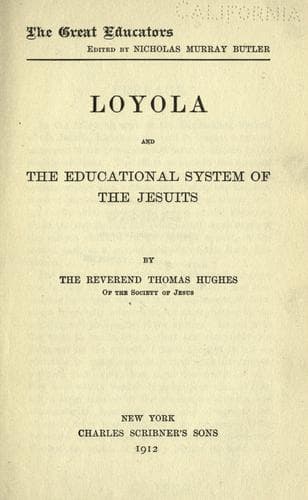
Loyola and the Educational System of the JesuitsHughes, Thomas
History
Loyola and the Educational System of the Jesuits
Hughes, Thomas
Education -- History; Ignatius, of Loyola, Saint, 1491-1556; Jesuits
Upon this basis of the amount of work done, as well as its intrinsic
character, shown by the results, I was going to draw some inferences
with regard to the amount of the temporal endowments, which must have
been required to support such a vast organization, and must have been
vested in the Order by the Christian world. One might compare the
work done with what Oxford accomplishes; and, seeing that the latter
university supplies the facilities for higher education, and that far
from gratuitously, to only a couple of thousands among the nobility
and gentry, then, since it spends upon this an annual revenue of
$2,500,000, how much would be required to conduct the education of a
quarter of a million of students? Our arithmetic would feel oppressed
by the calculation.
But the calculation is not necessary. It is quite evident that
religious poverty gave the key to the situation,--poverty,
self-abnegation, the resignation of all temporal considerations in
life, by men who had no families to provide for, no station to acquire;
who had themselves given up every station, from that of the clerical
benefice, or the liberal and martial careers, to ducal coronets,
princedoms, and even royalty; men therefore, who were bestowing with
themselves, and in themselves, the essential endowment of education
upon the world, and who needed only to have that supplemented with
the few temporal necessities still remaining. And the conclusion to
be drawn seems to be this. The Christian world, whether ruler or
people, republic or municipality, was making a safe and lucrative
investment, whether at home or abroad, in the midst of civilization
or of barbarism, when it consigned the absolute use of sufficient
temporalities to a world-wide faculty, inspired by the sentiment of
religious devotion.
For what is the object of any religious society whatsoever? It is to
complete in each of its members the duties of the man, the citizen
and the Christian, with other duties called "religious," which,
correlative with the former, are nevertheless distinct from them. They
are duties which presuppose the moral virtues, the civil and Christian
virtues, and tend to complete them with the highest qualities to which
perfect Christianity aspires, those of self-devotion and religious
self-consecration.
Public-domain text, read in full here on John Shaqi.
Reviews
Reviews
No reviews yet
Be the first to share your thoughts on this work.
Join the Discussion
Join the discussion
Sign in to leave a comment or review.
Sign InorCreate an account