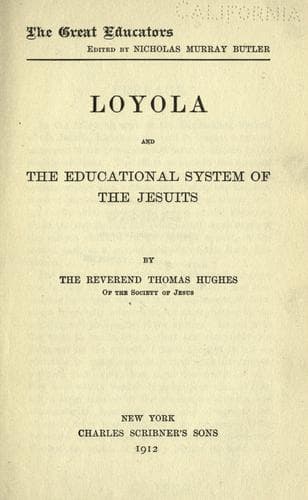
Loyola and the Educational System of the JesuitsHughes, Thomas
History
Loyola and the Educational System of the Jesuits
Hughes, Thomas
Education -- History; Ignatius, of Loyola, Saint, 1491-1556; Jesuits
Hence the experiences, making a drama and a tragedy, when the Society
abruptly disappeared. Supposing even that enough of competent men, with
all personal requirements, could have been found to fill the void, what
of their salaries and support? Take an instance. The revenues, which
at Bourges had been enough for the support of thirty Jesuits, were
found, after the Suppression of the Order, not to afford an adequate
compensation for ten secular Professors.[55] Frederic II of Prussia,
sending an agent to negotiate with Pius VI about retaining the Order in
his States, expresses himself thus in a letter to Voltaire: "The surest
means (to perpetuate a series of Professors) is to preserve a seminary
of men destined to teach. In studying the sciences, they fit themselves
for the office of instructing. It would be no easy task to fill
instantaneously a vacancy left by a skilful professor. If the education
of ordinary citizens be necessary, the training up of instructors must
be no less so." And then, coming to the point before us, the King
continues: "Besides, there are reasons of economy for preferring such
a body of men to mere secular individuals. The professor taken from
the latter class will cost more, because he has a greater number of
wants. It is needless to remark that the property of the Jesuits would
not be sufficient to remunerate their successors; and that revenues,
which pass over to the administration of the government, always suffer
diminution."[56] Speaking of Ganganelli, Pope Clement XIII, who was
under pressure from various quarters to make him suppress the Order,
Frederic writes to Voltaire in 1770: "For my own part, I have no
reason to complain of him; he leaves me my dear Jesuits, whom they are
persecuting everywhere. I will save the precious seed, to give some of
it, one day, to those who should wish to cultivate a plant so rare."[57]
The testimony of documents is uniform upon the poverty of these men,
whom Protestant historians like Grotius, Robertson, and others marvel
at, for the authority they possessed in the world, for the purity of
their lives, their success in teaching, and their art of commanding
with wisdom as they themselves obeyed with fidelity. Their life was
one of straitened circumstances and self-abnegation. We may see it
illustrated in Dilingen.[58] Or again, at the great royal college,
founded by Henri IV at La Flèche, where three hundred boarders were
supposed to be paying their own expenses, as _pensionnaires_, we
find Louis XIII issuing a royal decree that his magistrates are to
prosecute "les rétardataires et les récalcitrants par toutes les voyes
raisonnables," persons who did not pay the expenses of their own
children, but left that interesting occupation to the college. With
all that, says Rochemonteix, nothing came of it, neither of the royal
injunctions, nor of judicial suits; things went on the same way, "the
parents paying badly, and the treasurers lamenting."[59]
Public-domain text, read in full here on John Shaqi.
Reviews
Reviews
No reviews yet
Be the first to share your thoughts on this work.
Join the Discussion
Join the discussion
Sign in to leave a comment or review.
Sign InorCreate an account