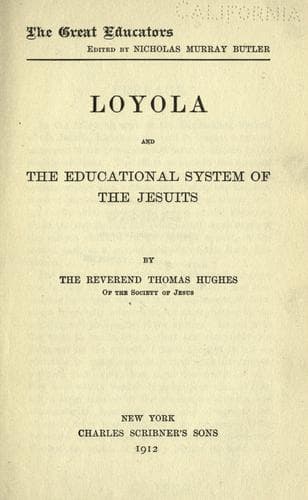
Loyola and the Educational System of the JesuitsHughes, Thomas
History
Loyola and the Educational System of the Jesuits
Hughes, Thomas
Education -- History; Ignatius, of Loyola, Saint, 1491-1556; Jesuits
The situation, which met the military view of the cavalier, lately
the knightly captain of Loyola, was a new one, on an old field of
battle. The demand, which it seemed to make upon tactical resources,
was as intense as the political and religious crisis which created the
situation. From the year 1522 till 1540, while Ignatius was prospecting
the scene in Europe, and preparing to take an active part in it, he
had time and the opportunities for observing, what precisely, at
that epoch, were the accumulated results of all the Christian ages
gone before; and why the results just then were only what they were.
The issue appeared fatally determined by social conditions around,
which more than neutralized the Christianity visible. Education, in
particular, was laboring under the action of causes, which had begun
to operate several centuries earlier, and which were then evidently
working themselves out to one final effort. That was the undermining of
Christian education.
In this respect, it was the same question which had confronted the
Augustines, the Basils, and Jeromes, of one thousand years before. But
it was a different state of the question. Augustine, the brilliant
youth of Hippo Regius in Africa, will serve as an instance of what
the issue then had been. He had made himself master of the very best
results, which the public schools of the time were able to accomplish
in the most gifted of minds. But he had lost his virtue. He lived to
complain with bitterness, that it was accounted a grievous error to
pronounce _homo_ "a man," without the "h," but it was no error at all
to hate a man, signified by the word, _homo_. The consequence with him
was that, when he became a Bishop of the Church, he met the need of
providing a Christian education, by instituting in his own house a kind
of school, for the moral and spiritual education of his clergy.
Thus arose the cathedral or canonical school. So too, the cloistral
schools came to flourish in the abbeys and the monasteries. And,
even if these two kinds of educational centres had not also been, as
they really were, in the Middle Ages, the preordained means for the
salvation of learning in Europe, they would still have had reason
enough for their existence, in the paramount necessity of continuing,
for the tender age of youth, the ministry of a virtuous education.
Events took a new turn with the rise and progress of the university
system. At first, the universities were mostly annexed to cathedral
churches. As they developed, the cloistral influence waned. And again,
as they developed still more, they presented phenomena which originated
the subsequent system of the Jesuits.
Public-domain text, read in full here on John Shaqi.
Reviews
Reviews
No reviews yet
Be the first to share your thoughts on this work.
Join the Discussion
Join the discussion
Sign in to leave a comment or review.
Sign InorCreate an account