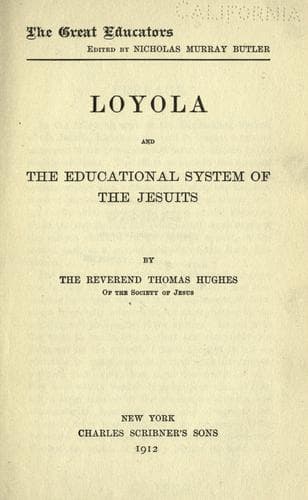
Loyola and the Educational System of the Jesuits — John Shaqi
Loyola and the Educational System of the JesuitsHughes, Thomas
History
Loyola and the Educational System of the Jesuits
Hughes, Thomas
Education -- History; Ignatius, of Loyola, Saint, 1491-1556; Jesuits
An indiscriminate mass of humanity like this, pressed, thronged, and
crowded together, stimulated with all the ardor, and alive with all the
passions of youth, could not fail to be little better than a nursery
for indiscriminate license. Whatever might be the vigilance of the
Church, or however strenuous the exercise of legitimate authority,
nothing in the usual course of human society could prevent its
becoming a prolific soil for the propagation of every species of error.
And, as during three hundred years the intellectual and educational
powers of Europe followed this course, the law of evolution asserted
itself in many directions.
On the one side, those tens of thousands of Christian youths, who
were aiming at all the posts of influence in Church and State, and
who, entering their native university, or journeying to foreign ones,
began life there at as early an age as twelve or fourteen years, to
remain in this environment some nine or twelve years more, became, as
was natural, the living, swarming members of a state of society so
dissolute, that successive occupants of the Papal See depicted the
condition of things as one of moral contagion. In the manner of thought
and mind which prevailed, no form of theoretic error was wanting.
In philosophy, there was scepticism; in theology, heresy; while, in
politics, Cæsarism and absolutism became rife. Then, at the end of
the fifteenth century, the Renaissance came; and one of the first
things, which it expressly and formally did, was to renew in life,
art, and politics, the same old paganism, upon the ruins of which, so
many centuries before, Christianity had begun its upward and laborious
ascent. Newly fashioning then much of what was old, Christianity had
augmented all this with so much which was new, that in a thousand
years it had made a Renaissance possible. And now the form of this
Renaissance threatened its own ascendancy in morals and in life.
On the other hand, the old spirit of conservatism in religion, and of
preservation in the matter of morals, maintained itself for a time,
through those bodies of religious men and clergymen, who had left
the cloister or the seminary, to take up their abode in the secular
seats of learning. It was this spirit which originated the latest and
best development of the universities, that of the "college" system,
established in their midst. Salamanca had twenty colleges; Louvain,
forty; Paris, fifty. Still, in the final issue, there was now scarcely
any reserve force of cloistral or episcopal learning behind the
universities, and outside of them. And the religious and the clergy
themselves, who at best were not a little out of their element from the
moment they migrated into the secular environment, conformed insensibly
to the conditions in which they found themselves, and so far ceased to
be the power they had been.
Public-domain text, read in full here on John Shaqi.
Reviews
Reviews
No reviews yet
Be the first to share your thoughts on this work.
Join the Discussion
Join the discussion
Sign in to leave a comment or review.
Sign InorCreate an account