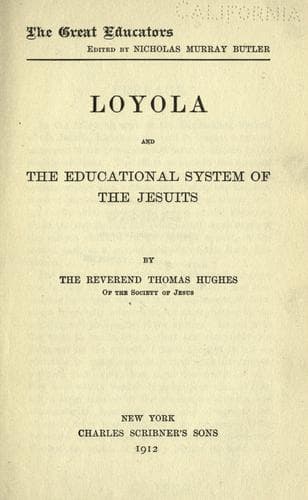
Loyola and the Educational System of the JesuitsHughes, Thomas
History
Loyola and the Educational System of the Jesuits
Hughes, Thomas
Education -- History; Ignatius, of Loyola, Saint, 1491-1556; Jesuits
Whatever, then, a man may think privately, and be free to think, in
matters of mere opinion, the genius of education imposes limits on
the manner and matter of his actual teaching; and the speculations
of a thinker, a writer, or an investigator, are not to be confounded
with the best results of an educator, who, doing his work in the best
way, is to effect a definite and immediate object. That object is
nothing less than the equipping of fresh young spirits with principles
of thought and habits of life, to enter fully appointed on their
respective paths of duty. In this view, therefore, definiteness of
matter, no less than unity of method, were required from the first for
an effective system of education.
During forty years, the individual enterprise of experienced and
responsible men had been interpreting the values and measuring the
results of existing methods. The Society itself had mounted into such
a position, as practically to command the whole field of secular
education. Its own system must have been excellent already. Nor could
that system have been uniformly excellent, but for some uniformity
which characterized it. Still the unity was defective. The Provinces
were petitioning for an improvement. Evils obstructed the way to
something better. For these reasons, the matter was taken in hand by
one General after another. And the final outcome of their work was a
"Form," or "Method of Studies," _Formula_, or _Ratio Studiorum_.
On the nineteenth day of February, 1581, Father Claudius Aquaviva
was elected fifth General Superior of the Society. Taking up this
educational project where his predecessors had left it, and, like
them, availing himself of his almost boundless resources for obtaining
information, he began by putting the work through every possible stage
of consultation, to which the traditions of his office, and his own
executive ability prompted him; and, when all prudent means had been
exhausted in deliberating, he then used the executive power which
was vested in him; and he required that what had been so laboriously
designed, by the united efforts of many, should henceforth be reduced
to practice, with the good will of all.
Public-domain text, read in full here on John Shaqi.
Reviews
Reviews
No reviews yet
Be the first to share your thoughts on this work.
Elsewhere in the archive
Join the Discussion
Join the discussion
Sign in to leave a comment or review.
Sign InorCreate an account