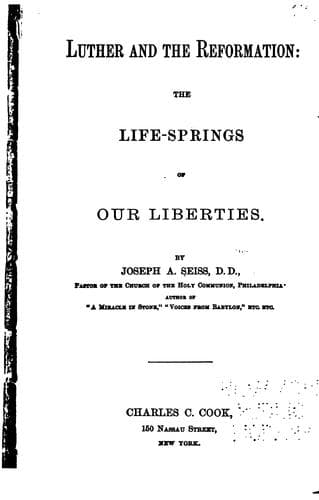
Luther and the Reformation:: The Life-Springs of Our LibertiesSeiss, Joseph Augustus
History
Luther and the Reformation:: The Life-Springs of Our Liberties
Seiss, Joseph Augustus
Luther, Martin, 1483-1546; Pennsylvania -- History -- Colonial period, ca. 1600-1775
John Calvin was a man of great learning and ability. Marked has been
his influence on the theology and government of a large portion of the
Reformed churches. But the Reformation was twelve years old before he
came into it. It had to exist already ere there could be a Calvin,
while his repeated flights to avoid danger prove how inadequate his
courage was for such unflinching duty as rendered Luther illustrious.
He was a cold, hard, ascetic aristocrat at best, more cynical, stern,
and tyrannical than brave. The organization for the Church and civil
government which he gave to Geneva was quite too intolerant and
inquisitorial for safe adoption in general or to endure the test of
the true Gospel spirit. Under a regime which burnt Servetus for
heresy, threw men into prison for reading novels, hung and beheaded
children for improper behavior toward parents, whipped and banished
people for singing songs, and dealt with others as public blasphemers
if they said a word against the Reformers or failed to go to church,
the cause of the Reformation could never have commanded acceptance by
the nations, or have survived had it been received. The famous "Blue
Laws" of the New England colonies have had to be given up as a scandal
upon enlightened civilization; but they were largely transcribed from
Calvin's code and counsels, including even the punishing of witches.
For the last two hundred years the Calvinistic peoples have been
reforming back from Calvin's rules and spirit, either to a better
foundation for the perpetuation and honor of the Church or to a
rationalistic skepticism which lets go all the distinctive elements of
the genuine Christian Creed--the natural reaction from the hard and
overstrained severity of a legalistic style of Christianity.
With all the great service Calvin has rendered to theological science
and church discipline, there was an unnatural sombreness about him,
which linked him rather with the Middle Ages and the hierarchical rule
than with the glad, free spirit of a wholesome Christian life. At
twenty-seven he had already drawn up a formula of doctrine and
organization which he never changed and to which he ever held. There
was no development either in his life or in his ideas. The evangelic
elements of his system he found ready to his hand, as thought out by
Luther and the German theologians. They did not originate or grow with
him. And had the Reformation depended upon him it could never have
become a success. So too with any others that might be named.
LUTHER THE CHOSEN INSTRUMENT.
We may not limit Providence. The work was to be done. Every interest
of the world and of the kingdom of God demanded it. And if there had
been no Luther at hand, some one else would have been raised up to
serve in his place. But there _was_ a Luther, and, as far as human
insight can determine, he was the only man on earth competent to
achieve the Reformation. And he it was who did achieve it.
Public-domain text, read in full here on John Shaqi.
Reviews
Reviews
No reviews yet
Be the first to share your thoughts on this work.
Join the Discussion
Join the discussion
Sign in to leave a comment or review.
Sign InorCreate an account