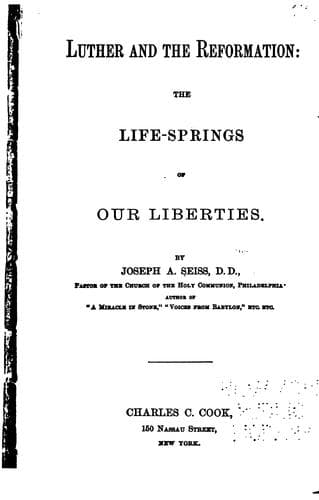
Luther and the Reformation:: The Life-Springs of Our Liberties — John Shaqi
Luther and the Reformation:: The Life-Springs of Our LibertiesSeiss, Joseph Augustus
History
Luther and the Reformation:: The Life-Springs of Our Liberties
Seiss, Joseph Augustus
Luther, Martin, 1483-1546; Pennsylvania -- History -- Colonial period, ca. 1600-1775
Looked at in advance, perhaps no one would have thought of him for
such an office. He was so humbly born, so lowly in station, so
destitute of fortune, and withal so honest a Papist, that not the
slightest tokens presented to mark him out as the chosen instrument to
grapple with the magnitudinous tyranny by which Europe was enthralled.
But "God hath chosen the weak things of the world to confound the
things that are mighty." Moses was the son of a slave. The founder of
the Hebrew monarchy was a shepherd-boy. The Redeemer-King of the world
was born in a stable and reared in the family of a village carpenter.
And we need not wonder that the hero-prophet of the modern ages was
the son of a poor toiler for his daily bread, and compelled to sing
upon the street for alms to keep body and soul together while
struggling for an education.
It has been the common order of Providence that the greatest lights
and benefactors of the race, the men who rose the highest above the
level of their kind and stood as beacons to the world, were not such
as would have been thought of in advance for the mighty services which
render their names immortal. And that the master spirit of the great
Reformation was no exception all the more surely identifies that
marvelous achievement as the work of an overruling God.
LUTHER'S ORIGIN.
Luther was a Saxon German--a German of the Germans--born of that blood
out of which, with but few exceptions, have sprung the ruling powers
of the West since the last of the old Roman emperors. He came out of
the bosom of the freshest, strongest, and hardiest peoples then
existing--the direct descendants of those wild Cimbrian and Teutonic
tribes who, even in their heathenism, were the most virtuous, brave,
and true of all the Gentiles.
Nor was he the offspring of enfeebled, gouty, aristocratic blood. He
was the son of the sinewy and sturdy yeomanry. Though tradition
reports one of his remote ancestors in something of imperial place
among the chieftains of the semi-savage tribes from which he was
descended, when the period of the Reformation came his family was in
like condition with that of the house of David when the Christ was
born. His father and grandfather and great-grandfather, he says
himself, were true Thuringian peasants.
LUTHER'S EARLY TRAINING.
In the early periods of the mediaeval Church her missionaries came to
these fiery warriors of the North and followed the conquests of
Charlemagne, to teach them that they had souls, that there is a living
and all-knowing God at whose judgment-bar all must one day stand to
give account, and that it would then be well with the believing,
brave, honest, true, and good, and ill with cowards, profligates, and
liars. It was a simple creed, but it took fast hold on the Germanic
heart, to show itself in sturdy power in the long after years.
Public-domain text, read in full here on John Shaqi.
Reviews
Reviews
No reviews yet
Be the first to share your thoughts on this work.
Join the Discussion
Join the discussion
Sign in to leave a comment or review.
Sign InorCreate an account