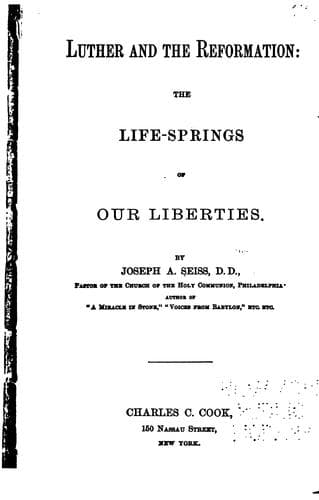
Luther and the Reformation:: The Life-Springs of Our Liberties — John Shaqi
Luther and the Reformation:: The Life-Springs of Our LibertiesSeiss, Joseph Augustus
History
Luther and the Reformation:: The Life-Springs of Our Liberties
Seiss, Joseph Augustus
Luther, Martin, 1483-1546; Pennsylvania -- History -- Colonial period, ca. 1600-1775
To Bossuet and Voltaire it was a mere squabble of the monks; to others
it was the cupidity of secular sovereigns and lay nobility grasping
for the power, estates, and riches of the Church. Some treat of it as
a simple reaction against religious scandals, with no great depths of
principle or meaning except to illustrate the recuperative power of
human society to cure itself of oppressive ills. Guizot describes it
as "a vast effort of the human mind to achieve its freedom--a great
endeavor to emancipate human reason." Lord Bacon takes it as the
reawakening of antiquity and the recall of former times to reshape and
fashion our own.
Whatever of truth some of these estimates may contain, they fall far
short of a correct idea of what the Reformation was, or wherein lay
the vital spring of that wondrous revolution. Its historic and
philosophic centre was vastly deeper and more potent than either or
all of these conceptions would make it. Many influences contributed to
its accomplishment, but its inmost principle was unique. The real
nerve of the Reformation was religious. Its life was something
different from mere earthly interests, utilities, aims, or passions.
_Its seat was in the conscience._ Its true spring was the soul,
confronted by eternal judgment, trembling for its estate before divine
Almightiness, and, on pain of banishment from every immortal good,
forced to condition and dispose itself according to the clear
revelations of God. It was not mere negation to an oppressive
hierarchy, except as it was first positive and evangelic touching the
direct and indefeasible relations and obligations of the soul to its
Maker. Only when the hierarchy claimed to qualify these direct
relations and obligations, thrust itself between the soul and its
Redeemer, and by eternal penalties sought to hold the conscience bound
to human authorities and traditions, did the Reformation protest and
take issue. Had the inalienable right and duty to obey God rather than
man been conceded, the hierarchy, as such, might have remained, the
same as monarchical government. But this the hierarchy negatived,
condemned, and would by no means tolerate. Hence the mighty contest.
And the heart, sum, and essence of the whole struggle was the
maintenance and the working out into living fact of this direct
obligation of the soul to God and the supreme authority of His clear
and unadulterated word.
SPIRITUAL TRAINING.
How Luther came to these principles, and the fiery trials by which
they were burnt into him as part of his inmost self, is one of the
most vital chapters in the history.
His father had designed him for the law. To this end he had gone
through the best schools of Germany, taken his master's degree, and
was advancing in the particular studies relating to his intended
profession, when a sudden change came over his life.
Public-domain text, read in full here on John Shaqi.
Reviews
Reviews
No reviews yet
Be the first to share your thoughts on this work.
Join the Discussion
Join the discussion
Sign in to leave a comment or review.
Sign InorCreate an account