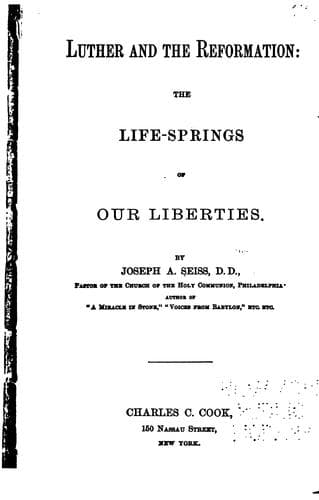
Luther and the Reformation:: The Life-Springs of Our LibertiesSeiss, Joseph Augustus
History
Luther and the Reformation:: The Life-Springs of Our Liberties
Seiss, Joseph Augustus
Luther, Martin, 1483-1546; Pennsylvania -- History -- Colonial period, ca. 1600-1775
Religious in his temper and training, and educated in a creed which
worked mainly on man's fears, without emphasizing the only basis of
spiritual peace, he fell into great terrors of conscience. Several
occurrences contributed to this: (1) He fell sick, and was likely to
die. (2) He accidentally severed an artery, and came near bleeding to
death. (3) A bosom friend of his was suddenly killed. All this made
him think how it would be with him if called to stand before God in
judgment, and filled him with alarm. Then (4) he was one day overtaken
by a thunderstorm of unwonted violence. The terrific scene presented
to his vivid fancy all the horrors of a mediaeval picture of the Last
Day, and himself about to be plunged into eternal fire. Overwhelmed
with terror, he cried to Heaven for help, and vowed, if spared, to
devote himself to the salvation of his soul by becoming a monk. His
father hated monkery, and he shared the feeling; but, if it would save
him, why hesitate? What was a father's displeasure or the loss of all
the favors of the world to his safety against a hopeless perdition?
Call it superstition, call it religious melancholy, call it morbid
hallucination, it was a most serious matter to the young Luther, and
out of it ultimately grew the Reformation. False ideas underlay the
resolve, but it was profoundly sincere and according to the ideas of
ages. It was wrong, but he could not correct the error until he had
tested it. And thus, by what he took as the unmistakable call of God,
he entered the cloister.
Never man went into a monastery with purer motives. Never a man went
through the duties, drudgeries, and humiliations of the novitiate of
convent-life with more unshrinking fidelity. Never man endured more
painful mental and bodily agonies that he might secure for himself an
assured spiritual peace. Romanists have expressed their wonder that so
pure a man thought himself so great a sinner. But a sinner he was, as
we all; and to avert the just anger of God he fasted, prayed, and
mortified himself like an anchorite of the Thebaid. And yet no peace
or comfort came.
A chained Bible lay in the monastery. He had previously found a copy
of it in the library of the university. Day and night he read it,
along with the writings of St. Augustine. In both he found the same
pictures of man's depravity which he realized in himself, but God's
remedy for sin he had not found. In the earnestness of his studies the
prescribed devotions were betimes crowded out, and then he punished
himself without mercy to redeem his failures. Whole nights and days
together he lay upon his face crying to God, till he swooned in his
agony. Everything his brother-monks could tell him he tried, but all
the resources of their religion were powerless to comfort him or to
beget a righteousness in which his anguished soul could trust.
Public-domain text, read in full here on John Shaqi.
Reviews
Reviews
No reviews yet
Be the first to share your thoughts on this work.
Join the Discussion
Join the discussion
Sign in to leave a comment or review.
Sign InorCreate an account