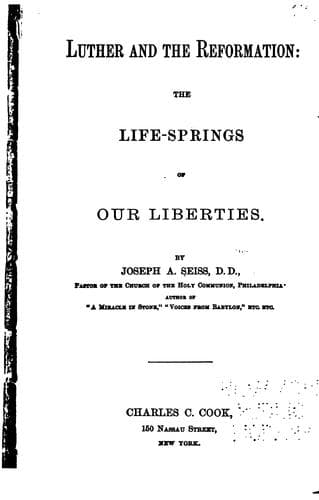
Luther and the Reformation:: The Life-Springs of Our Liberties — John Shaqi
Luther and the Reformation:: The Life-Springs of Our LibertiesSeiss, Joseph Augustus
History
Luther and the Reformation:: The Life-Springs of Our Liberties
Seiss, Joseph Augustus
Luther, Martin, 1483-1546; Pennsylvania -- History -- Colonial period, ca. 1600-1775
More than ten years passed before this new principle began to work off
the putrid carcass of mediaeval religion which lay stretched over the
stifled and suffocating Church of Christ. There were yet many steps
and stages in the preparation for what was to come. But from that time
forward everything moved toward general regeneration by means of that
marrow doctrine of the Gospel: _Salvation by loving faith in the merit
and mediation of Jesus alone_.
Staupitz counseled the young monk to study the Scriptures well and
whatever could aid him in their right understanding, and gave orders
to the monastery not to interfere with his studies.
On May 2, 1507, he was consecrated to the priesthood.
Within the year following, at the instance of Staupitz, Frederick the
Wise appointed him professor in the new University of Wittenberg.
May 9, 1509, he took his degree of bachelor of divinity. From that
time he began to use his place to attack the falsehoods of the
prevailing philosophy and to explore and expose the absurdities of
Scholasticism, dwelling much on the great Gospel treasure of God's
free amnesty to sinful man through the merits and mediation of Jesus
Christ, on which his own soul was planted.
Staupitz was astounded at the young brother's thorough mastery of the
sacred Word, the minuteness of his knowledge of it, and the power with
which he expounded and defended the great principles of the evangelic
faith. So able a teacher of the doctrines of the cross must at once
begin to preach. Luther remonstrated, for it was not then the custom
for all priests to preach. He insisted that he would die under the
weight of such responsibilities. "Die, then," said Staupitz; "God has
plenty to do for intelligent young men in heaven."
A little old wooden chapel, daubed with clay, twenty by thirty feet in
size, with a crude platform of rough boards at one end and a small
sooty gallery for scarce twenty persons at the other, and propped on
all sides to keep it from tumbling down, was assigned him as his
cathedral. Myconius likens it to the stable of Bethlehem, as there
Christ was born anew for the souls which now crowded to it. And when
the thronging audiences required his transfer to the parish church, it
was called the bringing of Christ into the temple.
Public-domain text, read in full here on John Shaqi.
Reviews
Reviews
No reviews yet
Be the first to share your thoughts on this work.
Join the Discussion
Join the discussion
Sign in to leave a comment or review.
Sign InorCreate an account