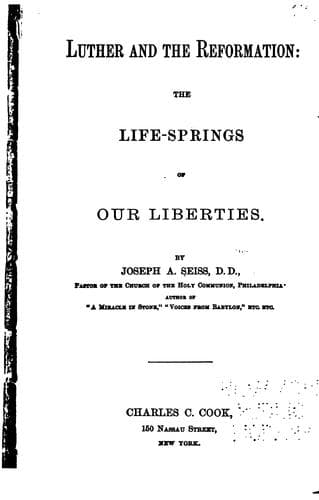
Luther and the Reformation:: The Life-Springs of Our LibertiesSeiss, Joseph Augustus
History
Luther and the Reformation:: The Life-Springs of Our Liberties
Seiss, Joseph Augustus
Luther, Martin, 1483-1546; Pennsylvania -- History -- Colonial period, ca. 1600-1775
It happened that one of the exceptionally enlightened and
spiritual-minded monks of his time, _John Staupitz_, was then the
vicar-general of the Augustinians in Saxony. On his tour of inspection
he came to Erfurt, and there found Luther, a walking skeleton, more
dead than alive. He was specially drawn to the haggard young brother.
The genial and sympathizing spirit of the vicar-general made Luther
feel at home in his presence, and to him he freely opened his whole
heart, telling of his feelings, failures, and fears--his heartaches,
his endeavors, his disappointments, and his despair. And God put the
right words into the vicar-general's mouth.
"Look to the wounds of Jesus," said he, "and to the blood he shed for
you, and there see the mercy of God. Cast yourself into the Redeemer's
arms, and trust in his righteous life and sacrificial death. He loved
you first; love him in return, and let your penances and
mortifications go."
The oppressed and captive spirit began to feel its burden lighten
under such discourse. God a God of love! Piety a life of love!
Salvation by loving trust in a God already reconciled in Christ! This
was a new revelation. It brought the sorrowing young Luther to the
study of the Scriptures with a new object of search. He read and
meditated, and began to see the truth of what his vicar said. But
doubts would come, and often his gloom returned.
One day an aged monk came to his cell to comfort him. He said he only
knew his Creed, but in that he rested, reciting, "_I believe in the
forgiveness of sins_."--"And do I not believe that?" said
Luther.--"Ah," said the old monk, "you believe in the forgiveness of
sins for David and Peter and the thief on the cross, but you do not
believe in the forgiveness of sins _for yourself_. St. Bernard says
the Holy Ghost speaks it to your own soul, _Thy_ sins are forgiven
_thee_."
And so at last the right nerve was touched. The true word of God's
deliverance was brought home to Luther's understanding. He was
penitent and in earnest, and needed only this great Gospel hope to
lift him from the horrible pit and the miry clay. As a light from
heaven it came to his soul, and there remained, a comfort and a joy.
The glad conclusion flashed upon him, never more to be shaken, "If
God, for Christ's sake, takes away our sins, then they are not taken
away by any works of ours."
The foundation-rock of a new world was reached.
Luther saw not yet what all this discovery meant, nor whither it would
lead. He was as innocent of all thought of being a Reformer as a
new-born babe is of commanding an army on the battlefield. But the
Gospel principle of deliverance and salvation for his oppressed and
anxious soul was found, and it was found for all the world. The anchor
had taken hold on a new continent. In essence the Great Reformation
was born--born in Luther's soul.
LUTHER'S DEVELOPMENT.
Public-domain text, read in full here on John Shaqi.
Reviews
Reviews
No reviews yet
Be the first to share your thoughts on this work.
Join the Discussion
Join the discussion
Sign in to leave a comment or review.
Sign InorCreate an account