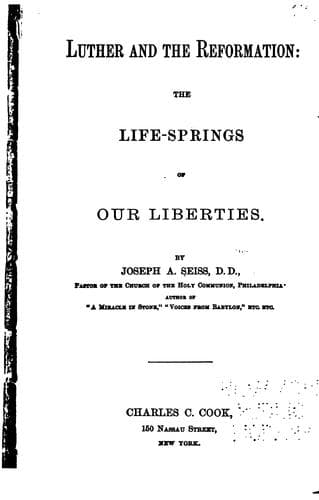
Luther and the Reformation:: The Life-Springs of Our Liberties — John Shaqi
Luther and the Reformation:: The Life-Springs of Our LibertiesSeiss, Joseph Augustus
History
Luther and the Reformation:: The Life-Springs of Our Liberties
Seiss, Joseph Augustus
Luther, Martin, 1483-1546; Pennsylvania -- History -- Colonial period, ca. 1600-1775
In his sermons, lectures, and disquisitions the results of these
incessant studies came out with a depth of penetration, a clearness of
statement, a simplicity of utterance, a devoutness of spirit, and a
convincing power of eloquence which, with the eminent sanctity of his
life, won for him unbounded praise. The common feeling was that the
earth did not contain another such a doctor and had not seen his equal
for many ages. Envy and jealousy themselves, those green-eyed monsters
which gather about the paths of great qualities and successes, seemed
for the time to be paralyzed before a brilliancy which rested on such
humility, conscientiousness, fidelity, and merit.
LUTHER'S LABORS.
Years of fruitful labor passed. The Decalogue was expounded. Paul's
letter to the Romans and the penitential Psalms were explained. The
lectures on the Epistle to the Galatians were nearly completed. But no
book from Luther had yet been published.
In 1515 he was chosen district vicar of the Augustinian monasteries of
Meissen and Thuringia. It was a laborious office, but it gave him new
experiences, familiarized him still more with the monks, brought him
into executive administrations, and developed his tact in dealing with
men.
One other particular served greatly to establish him in the hearts of
the people. A deadly plague broke out in Wittenberg. Citizens were
dying by dozens and scores. At a later period a like scourge visited
Geneva, and so terrified Calvin and his ministerial associates that
they appealed to the Supreme Council, entreating, "Mighty lords,
release us from attending these infected people, for our lives are in
peril." Not so Luther. His friends said, "Fly! fly!" lest he should
fall by the plague and be lost to the world. "Fly?" said he. "No, no,
my God. If I die, I die. The world will not perish because a monk has
fallen. I am not St. Paul, not to fear death, but God will sustain
me." And as an angel of mercy he remained, ministering to the sick and
dying and caring for the orphans and widows of the dead.
COLLISION WITH THE HIERARCHY.
Such was Luther up to the time of his rupture with Rome. He knew
something of the shams and falsities that prevailed, and he had
assailed and exposed many of them in his lectures and sermons; but to
lead a general reformation was the farthest from his thoughts. Indeed,
he still had such confidence in the integrity of the Roman Church that
he did not yet realize how greatly a thorough general reformation was
needed. Humble in mind, peaceable in disposition, reverent toward
authority, loving privacy, and fully occupied with his daily studies
and duties, it was not in him to think of making war with powers whose
claims he had not yet learned to question.
Public-domain text, read in full here on John Shaqi.
Reviews
Reviews
No reviews yet
Be the first to share your thoughts on this work.
Join the Discussion
Join the discussion
Sign in to leave a comment or review.
Sign InorCreate an account