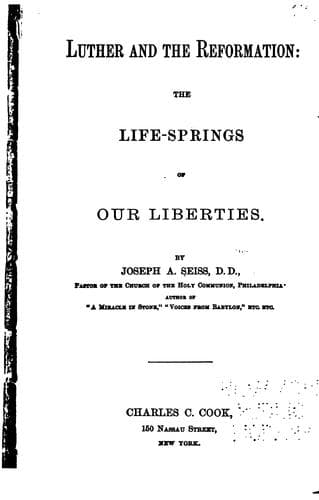
Luther and the Reformation:: The Life-Springs of Our LibertiesSeiss, Joseph Augustus
History
Luther and the Reformation:: The Life-Springs of Our Liberties
Seiss, Joseph Augustus
Luther, Martin, 1483-1546; Pennsylvania -- History -- Colonial period, ca. 1600-1775
But it was not possible that so brave, honest, and self-sacrificing a
man should long pursue his convictions without coming into collision
with the Roman high priesthood. Though far off at Wittenberg, and
trying to do his own duty well in his own legitimate sphere, it soon
came athwart his path in a form so foul and offensive that it forced
him to assault it. Either he had to let go his sincerest convictions
and dearest hopes or protest had to come. His personal salvation and
that of his flock were at stake, and he could in no way remain a true
man and not remonstrate. Driven to this extremity, and struck at for
his honest faithfulness, he struck again; and so came the battle which
shook and revolutionized the world.
THE SELLING OF INDULGENCES.
Luther's first encounter with the hierarchy was on the traffic in
indulgences. It was a good fortune that it there began. That traffic
was so obnoxious to every sense of propriety that any vigorous attack
upon it would command the approval of many honest and pious people.
The central heresy of hierarchical religion was likewise embodied in
it, so that a stab there, if logically followed up, would necessarily
reach the very heart of the oppressive monster. And Providence
arranged that there the conflict should begin.
Leo X. had but recently ascended the papal throne. Reared amid lavish
wealth and culture, he was eager that his reign should equal that of
Solomon and the Caesars. He sought to aggrandize his relatives, to
honor and enrich men of genius, and to surround himself with costly
splendors and pleasures. These demanded extraordinary revenues. The
projects of his ambitious predecessors had depleted the papal coffers.
He needed to do something on a grand scale in order adequately to
replenish his exchequer.
As early as the eleventh century the popes had betimes resorted to the
selling of pardons and the issuing of free passes to heaven on
consideration of certain services or payments to the Church. From
Urban II. to Leo X. this was more or less in vogue--first, to get
soldiers for the holy wars,[4] and then as a means of wealth to the
Church. If one wished to eat meat on fast-days, marry within
prohibited degrees of relationship, or indulge in forbidden pleasures,
he could do it without offence by rendering certain satisfactions
before or after, which satisfactions could mostly be made by payments
of money.[5] In the same way he could buy remission of sins in
general, or exemption for so many days, years, or centuries from the
pains of Purgatory. Bulls of authority were given, in the name of the
Father, Son, and Holy Ghost, to issue certificates of exemption from
all penalties to such as did the service or paid the equivalent.
Immense incomes were thus realized. Even to the present this facile
invention for raising money has not been entirely discontinued. Papal
indulgences can be bought to-day in the shops of Spain and elsewhere.
Public-domain text, read in full here on John Shaqi.
Reviews
Reviews
No reviews yet
Be the first to share your thoughts on this work.
Join the Discussion
Join the discussion
Sign in to leave a comment or review.
Sign InorCreate an account