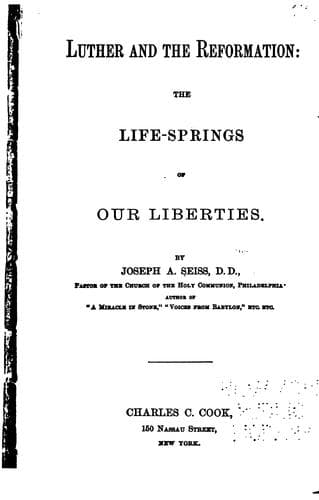
Luther and the Reformation:: The Life-Springs of Our Liberties — John Shaqi
Luther and the Reformation:: The Life-Springs of Our LibertiesSeiss, Joseph Augustus
History
Luther and the Reformation:: The Life-Springs of Our Liberties
Seiss, Joseph Augustus
Luther, Martin, 1483-1546; Pennsylvania -- History -- Colonial period, ca. 1600-1775
Leo seized upon this system with all the vigor and unscrupulousness
characteristic of the Medici. Had he been asked whether he really
believed in these pardons, he would have said that the Church always
believed the pope had power to grant them. Had he spoken his real mind
in the matter, he would have said that if the people chose to be such
fools, it was not for him to find fault with them. And thus, under
plea of raising funds to finish St. Peter's, he instituted a grand
trade in indulgences, and thereby laid the capstone of hierarchical
iniquity which crushed the whole fabric to its base.
The right to sell these wares in Germany was awarded to Albert, the
gay young prince-archbishop of Mayence. He was over head and ears in
debt to the pope for his pallium, and Leo gave him this chance to get
out.[6] Half the proceeds of the trade in his territory were to go to
his credit. But the work of proclaiming and distributing the pardons
was committed to _John Tetzel_, a Dominican prior who had long
experience in the business, and who achieved "a forlorn notoriety in
European history" by his zeal in prosecuting it.
FOOTNOTES:
[4] In the famous Bull of Gregory IX., published in 1234, that pope
exhorts and commands all good Christians to take up the cross and join
the expedition to recover the Holy Land. The language is: "The service
to which mankind are now invited is an effectual atonement for the
miscarriages of a negligent life. The discipline of a regular penance
would have discouraged many offenders so much that they would have had
no heart to venture upon it; but the holy war is a compendious method
of discharging men from guilt and restoring them to the divine favor.
Even if they die on their march, the intention will be taken for the
deed, and many in this way may be crowned without fighting."--Given in
Collier's _Eccl._, vol. i.
[5] The Roman Chancery once put forth a book, which went through many
editions, giving the exact prices for the pardon of each particular
sin. A deacon guilty of murder was absolved for twenty pounds. A
bishop or abbot might assassinate for three hundred livres. Any
ecclesiastic might violate his vows of chastity for the third part of
that sum, etc., etc.--See Robertson's _Charles V._
[6] The pallium, or pall, was a narrow band of white wool to go over
the shoulders in the form of a circle, from which hung bands of
similar size before and behind, finished at the ends with pieces of
sheet lead and embroidered with crosses. It was the mark of the
dignity and rank of archbishops. Albert owed Pope Leo X. forty-five
thousand thalers for his right and appointment to wear the
archbishop's pallium.
Public-domain text, read in full here on John Shaqi.
Reviews
Reviews
No reviews yet
Be the first to share your thoughts on this work.
Join the Discussion
Join the discussion
Sign in to leave a comment or review.
Sign InorCreate an account