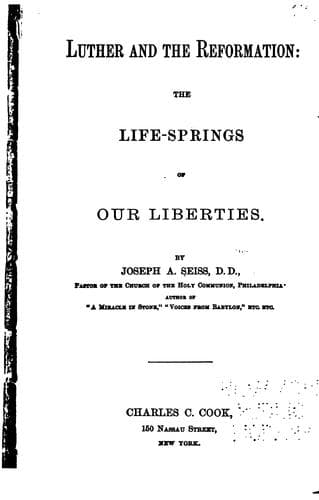
Luther and the Reformation:: The Life-Springs of Our LibertiesSeiss, Joseph Augustus
History
Luther and the Reformation:: The Life-Springs of Our Liberties
Seiss, Joseph Augustus
Luther, Martin, 1483-1546; Pennsylvania -- History -- Colonial period, ca. 1600-1775
"I hold it impossible," said he, "to prove from the Holy Scriptures
that divine justice demands from the sinner any other penance or
satisfaction than a true repentance, a change of heart, a willing
submission to bear the Saviour's cross, and a readiness to do what
good he can.
"That indulgences applied to souls in Purgatory serve to remit the
punishments which they would otherwise suffer is an opinion devoid of
any foundation.
"Indulgences, so far from expiating or cleansing from sin, leave the
man in the same filth and condemnation in which they find him.
"The Church exacts somewhat of the sinner, and what it on its own
account exacts it can on its own account remit, but nothing more.
"If you have aught to spare, in God's name give it for the building of
St. Peter's, but do not buy pardons.
"If you have means, feed the hungry, which is of more avail than
piling stones together, and far better than the buying of indulgences.
"My advice is, Let indulgences alone; leave them to dead and sleepy
Christians; but see to it that ye be not of that kind.
"Indulgences are neither commanded nor approved of God. They excite no
one to sanctification. They work nothing toward salvation.
"That indulgences have virtue to deliver souls from Purgatory I do not
believe, nor can it be proven by them that teach it; the Church says
nothing to that effect.
"What I preach to you is based on the certainty of the Holy
Scriptures, which no one ought to doubt."
So Luther preached, and his word went out to the ends of the earth. It
was no jest, like Ulric von Huetten's _Epistles of Obscure Men_, or
like the ridicule which Reuchlin and Erasmus heaped upon the stupid
monks. It raised no laugh, but penetrated, like a rifle-shot, into the
very heart of things.
Those who listened were deeply affected by the serious boldness of the
preacher. The audience was with him in conviction, but many trembled
for the result. "Dear doctor, you have been very rash; what trouble
may come of this!" said a venerable father as he pulled the sleeve of
Luther's gown and shook his head with misgivings. "If this is not
rightly done in God's name," said Luther, "it will come to nothing; if
it is, let come what will."
It was honest duty to God, truth, and the salvation of men that moved
him. Cowardly policy or timid expediency in such a matter was totally
foreign to his soul.
In a few days, the substance of the sermon was in print. Tetzel raved
over it. Melanchthon says he burnt it in the market-place of
Jueterbock. In the name of God and the pope he bade defiance to its
author, and challenged him by fire and water. Luther laughed at him
for braying so loud at a distance, yet declining to come to Wittenberg
to argue out the matter in close lists.
APPEAL TO THE BISHOPS.
Public-domain text, read in full here on John Shaqi.
Reviews
Reviews
No reviews yet
Be the first to share your thoughts on this work.
Join the Discussion
Join the discussion
Sign in to leave a comment or review.
Sign InorCreate an account