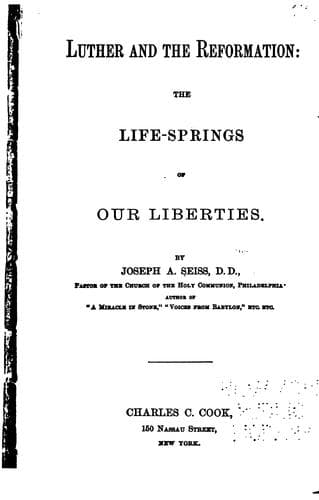
Luther and the Reformation:: The Life-Springs of Our LibertiesSeiss, Joseph Augustus
History
Luther and the Reformation:: The Life-Springs of Our Liberties
Seiss, Joseph Augustus
Luther, Martin, 1483-1546; Pennsylvania -- History -- Colonial period, ca. 1600-1775
Anxious to vindicate the Church from what he believed to be an
unwarranted liberty in the use of her name, Luther wrote to the bishop
of Brandenburg and the archbishop of Mayence. He made his points, and
appealed to these his superiors to put down the scandalous falsities
advanced by Tetzel. They failed to answer in any decisive way. The one
timidly advised silence, and the other had too much pecuniary interest
in the business to notice the letter.
Thus, as a pastor, Luther had taken his ground before his parishioners
in the confessional. As a preacher he had uttered himself in earnest
admonition from the pulpit. As a loyal son he had made his
presentation and appeal to those in authority over him. Was he right?
or was he wrong? No commanding answer came, and there remained one
other way of testing the question. As a doctor of divinity he could
lawfully, as custom had been, demand an open and fair discussion of
the matter with teachers and theologians. And upon this he now
resolved.
THE NINETY-FIVE THESES.
He framed a list of propositions on the points in question. They were
in Latin, for his appeal was to theologians, and not yet to the common
heart and mind of Germany. To make them public, he took advantage of a
great festival at Wittenberg, when the town was full of visitors and
strangers, and nailed them to the door of the new castle church,
October 31, 1517.
These were the famous _Ninety-five Theses_. They were plainly-worded
statements of the same points he had made in the confessional and in
his sermon. They contained no assault upon the Church, no arraignment
of the pope, no personal attack on any one. Neither were they given as
necessarily true, but as what Luther believed to be true, and the real
truth or falsity of which he desired to have decided in the only way
questions of faith and salvation can be rightly decided.
The whole matter was fairly, humbly, and legitimately put. "I, Martin
Luther, Augustinian at Wittenberg," he added at the end, "hereby
declare that I have written these propositions against indulgences. I
understand that some, not knowing what they affirm, are of opinion
that I am a heretic, though our renowned university has not condemned
me, nor any temporal or spiritual authority. Therefore, now again, as
often heretofore, I beg of one and all, for the sake of the true
Christian faith, to show me the better way, if peradventure they have
learned it from above, or at least to submit their opinion to the
decision of God and the Church; for I am not so insane as to set up my
views above everything and everybody, nor so silly as to accept the
fables invented by men in preference to the Word of God."
It is from the nailing up of these _Theses_ that the history of the
Great Reformation dates; for the hammer-strokes which fixed that
parchment started the Alpine avalanche which overwhelmed the pride of
Rome and broke the stubborn power which had reigned supreme for a
thousand years.
EFFECT OF THE THESES.
Public-domain text, read in full here on John Shaqi.
Reviews
Reviews
No reviews yet
Be the first to share your thoughts on this work.
Join the Discussion
Join the discussion
Sign in to leave a comment or review.
Sign InorCreate an account