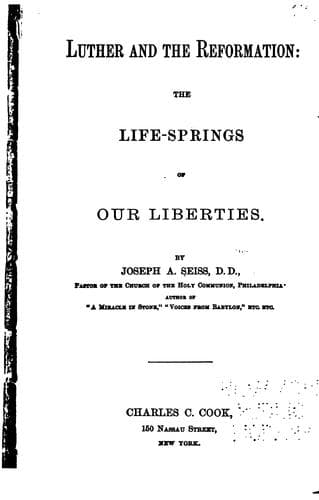
Luther and the Reformation:: The Life-Springs of Our Liberties — John Shaqi
Luther and the Reformation:: The Life-Springs of Our LibertiesSeiss, Joseph Augustus
History
Luther and the Reformation:: The Life-Springs of Our Liberties
Seiss, Joseph Augustus
Luther, Martin, 1483-1546; Pennsylvania -- History -- Colonial period, ca. 1600-1775
But Luther remained firm at his post. He honestly believed what he had
written, and he was not afraid of the truth. If the powers of the
world should come down upon him and kill him, he was prepared for the
slaughter. In all the mighty controversy he was ever ready to serve
the Gospel with his life or with his death.
TETZEL'S END.
Tetzel continued to bray and fume against him from pulpit and press,
denouncing him as a heresiarch, heretic, and schismatic. By Wimpina's
aid he issued a reply to Luther's sermon, and also counter-theses on
Luther's propositions. But the tide was turning in the sea of human
thinking. Luther's utterances had turned it. The people were ready to
tear the mountebank to pieces. Two years later he imploringly
complained to the pope's nuncio, Miltitz, that such fury pursued him
in Germany, Bohemia, Hungary, and Poland that he was nowhere safe.
Even the representative of the pope gave the wretch no sympathy. When
Luther heard of his illness he sent him a letter to tell him that he
had forgiven him all. He died in Leipsic, neglected, smitten in soul,
and full of misery, July 14, 1519.
LUTHER'S GROWING INFLUENCE.
Six months after the nailing up of the Theses, Luther was the hero of
a general convention of the Augustinians in Heidelberg. He there
submitted a series of propositions on philosophy and theology, which
he defended with such convincing clearness and tact that he won for
himself and his university great honor and renown. Better still, four
learned young men who there heard him saw the truth of his positions,
and afterward became distinguished defenders of the Reformation.
His cause, meanwhile, was rapidly gaining friends. His replies to
Tetzel, Prierias, Hochstrat, and Eck had gone forth to deepen the
favorable impression made by the Ninety-five Theses. Truth had once
more lifted up its head in Europe, and Rome would find it no child's
play to put it down. The skirmish-lines of the hierarchy had been met
and driven in. The tug of serious battle was now to come.
HIS APPEAL TO THE POPE.
Public-domain text, read in full here on John Shaqi.
Reviews
Reviews
No reviews yet
Be the first to share your thoughts on this work.
Join the Discussion
Join the discussion
Sign in to leave a comment or review.
Sign InorCreate an account