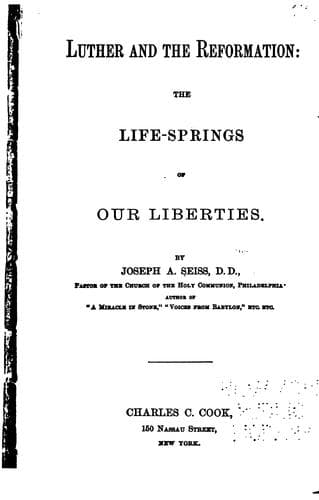
Luther and the Reformation:: The Life-Springs of Our Liberties — John Shaqi
Luther and the Reformation:: The Life-Springs of Our LibertiesSeiss, Joseph Augustus
History
Luther and the Reformation:: The Life-Springs of Our Liberties
Seiss, Joseph Augustus
Luther, Martin, 1483-1546; Pennsylvania -- History -- Colonial period, ca. 1600-1775
Luther made the advance. He wrote out explanations (or
"_Resolutions_") of his Theses, and sent them, with a letter, to the
pope. With great confidence, point, and elegance, but with equal
submissiveness and humility, he spoke of the completeness of Christ
for the salvation of every true believer, without room or need for
penances and other satisfactions; of the evilness of the times, and
the pressing necessity for a general reform; of the damaging
complaints everywhere resounding against the traffic in indulgences;
of his unsuccessful appeals to the ecclesiastical princes; and of the
unjust censures being heaped upon him for what he had done, entreating
His Holiness to instruct his humble petitioner, and condemn or
approve, kill or preserve, as the voice of Christ through him might
be. He then believed that God's sanction had to come through the high
clergy and heads of the Church. Many good Christians had approved his
Theses, but he did not recognize in that the divine answer to his
testimony. He said afterward: "I looked only to the pope, the
cardinals, the bishops, the theologians, the jurisconsults, the monks,
the priests, from whom I expected the breathing of the Spirit." He had
not yet learned what a bloody dragon claimed to impersonate the Lamb
of God.
CITATION TO ANSWER FOR HERESY.
While, in open frankness, Luther was thus meekly committing himself to
the powers at Rome, _they_ were meditating his destruction.
Insidiously they sought to deprive him of the Elector's protection,
and answered his humble and confiding appeal with a citation to appear
before them to answer for heresy.
Things now were ominous of evil. Wittenberg was filled with
consternation. If Luther obeyed, it was evident he would perish like
so many faithful men before him; if he refused, he would be charged
with contumacy and involve his prince. One and another expedient were
proposed to meet the perplexity; but to secure a hearing in Germany
was all Luther asked.
To this the pope proved more willing than was thought. He was not sure
of gaining by the public trial and execution of a man so deeply
planted in the esteem of his countrymen, and by bringing him before a
prudent legate he might induce him to retract and the trouble be
ended; if not, it would be a less disturbing way of getting possession
of the accused man. Orders were therefore issued for Luther to appear
before Cardinal Cajetan at Augsburg.
LUTHER BEFORE CAJETAN.
On foot he undertook the journey, believed by all to be a journey to
his death. But Maximilian, then in the neighborhood of Augsburg, gave
him a safe-conduct, and Cajetan was obliged to receive him with
civility. He even embraced him with tokens of affection, thinking to
win him to retraction. Luther was much softened by these kindly
manifestations, and was disposed to comply with almost anything if
not required to deny the truth of God.
Public-domain text, read in full here on John Shaqi.
Reviews
Reviews
No reviews yet
Be the first to share your thoughts on this work.
Join the Discussion
Join the discussion
Sign in to leave a comment or review.
Sign InorCreate an account