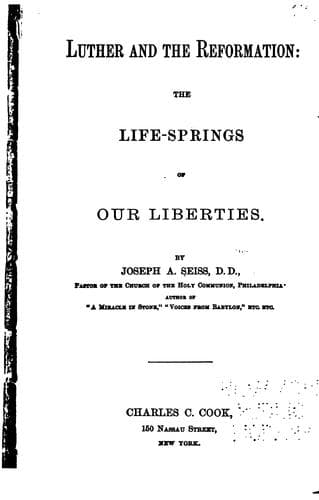
Luther and the Reformation:: The Life-Springs of Our LibertiesSeiss, Joseph Augustus
History
Luther and the Reformation:: The Life-Springs of Our Liberties
Seiss, Joseph Augustus
Luther, Martin, 1483-1546; Pennsylvania -- History -- Colonial period, ca. 1600-1775
Governor Printz arrived in this country in 1642, and with him came
Rev. John Campanius as chaplain and pastor of the Swedish colony. His
grandson, Thomas Campanius Holm, many years after published numerous
items put on record by the elder Campanius, in which it appears that
the commands to Printz respecting the Indians were very scrupulously
carried out.
According to these records, the Indians were very familiar at the
house of the elder Campanius, and he did much to teach and
Christianize them. "He generally succeeded in making them understand
that there is one Lord God, self-existent and one in three Persons;
how the same God made the world, and made man, from whom all other men
have descended; how Adam afterward disobeyed, sinned against his
Creator, and involved all his descendants in condemnation; how God
sent his only-begotten Son Jesus Christ into the world, who was born
of the Virgin Mary and suffered for the saving of men; how he died
upon the cross, and was raised again the third day; and, lastly, how,
after forty days, he ascended into heaven, whence he will return at a
future day to judge the living and the dead," etc. And so much
interest did they take in these instructions, and seemed so well
disposed to embrace Christianity, that Campanius was induced to study
and master their language, that he might the more effectually teach
them the religion of Christ. He also translated into the Indian
language the Catechism of Luther, perhaps the very first book ever put
into the Indian tongue.
Campanius began his work of evangelizing these wild people four years
before Eliot, who is sometimes called "the morning star of missionary
enterprise," but who first commenced his labors in New England only in
1646. Hence Dr. Clay remarks that "the Swedes may claim the honor of
having been the first missionaries among the Indians, at least in
Pennsylvania."[36] "It was, _in fact, the Swedes who inaugurated the
peaceful policy of William Penn_. This was not an accidental
circumstance in the Swedish policy, but was deliberately adopted and
always carefully observed."[37]
Public-domain text, read in full here on John Shaqi.
Reviews
Reviews
No reviews yet
Be the first to share your thoughts on this work.
Elsewhere in the archive
Join the Discussion
Join the discussion
Sign in to leave a comment or review.
Sign InorCreate an account