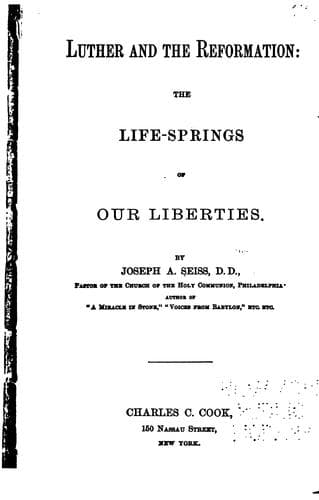
Luther and the Reformation:: The Life-Springs of Our Liberties — John Shaqi
Luther and the Reformation:: The Life-Springs of Our LibertiesSeiss, Joseph Augustus
History
Luther and the Reformation:: The Life-Springs of Our Liberties
Seiss, Joseph Augustus
Luther, Martin, 1483-1546; Pennsylvania -- History -- Colonial period, ca. 1600-1775
Erasmus was a notable man, great in talent and of great service in
preparing the way for the Reformation. He turned reviving learning to
the study of the Word. He produced the first, and for a long time the
only, critical edition of the New Testament in the original, to which
he added a Latin translation and notes. He paraphrased the Epistle to
the Romans--that great Epistle on which above all, the Reformation
moved. Though once an inmate of a monastery, he abhorred the monks and
exposed them with terrible severity. He had more friends, reputation,
and influence than perhaps any other private man in Europe. And he was
deep in the spirit of opposition to the scandalous condition of things
in the Church. But he never could have given us the Reformation. He
said all honest men sided with Luther, and as an honest man his place
would have been by Luther's side; but he was too great a coward. "If I
should join Luther," said he, "I could only perish with him, and I do
not mean to run my neck into the halter. Let popes and emperors
settle matters."--"Your Holiness says, Come to Rome; you might as well
tell a crab to fly. If I write calmly against Luther, I shall be
called lukewarm; if I write as he does, I shall stir up a hornet's
nest.... Send for the best and wisest men in Christendom, and follow
their advice."--"Reduce the dogmas necessary to be believed to the
smallest possible number. On other points let every one believe as he
likes. Having done this, quietly correct the abuses of which the world
justly complains."
So wrote Erasmus to the pope and to the archbishop of Mayence. Such
was his ideal of reformation--a thing as impossible to bring into
practical effect as its realization would have been absurd. It is easy
to tell a crab to fly, but will he do it? As well propose to convert
infallibility with a fable of AEsop as to count on bringing
regeneration to the hierarchy by such counsels.
The waters were too deep and the storms too fierce for the vacillating
Erasmus. He did some excellent service in his way, but all his
counsels and ideas failed, as they deserved. Once the idol of Europe,
he died a defeated, crushed, and miserable man. "Hercules could not
fight two monsters at once," said he, "while I, poor wretch! have
lions, cerberuses, cancers, scorpions, every day at my sword's
point.... There is no rest for me in my age, unless I join Luther; and
that I cannot, for I cannot accept his doctrines. Sometimes I am stung
with desire to avenge my wrongs; but my heart says, Will you in your
spleen raise hand against your mother who begot you at the font? I
cannot do it. Yet, because I bade monks remember their vows; because I
told persons to leave off their wranglings and read the Bible; because
I told popes and cardinals to look to the apostles and be more like
them,--the theologians say I am their enemy."
Thus in sorrow and in clouds Erasmus passed away, as would the entire
Reformation in his hands.
ULRIC VON HUeTTEN.
Public-domain text, read in full here on John Shaqi.
Reviews
Reviews
No reviews yet
Be the first to share your thoughts on this work.
Join the Discussion
Join the discussion
Sign in to leave a comment or review.
Sign InorCreate an account