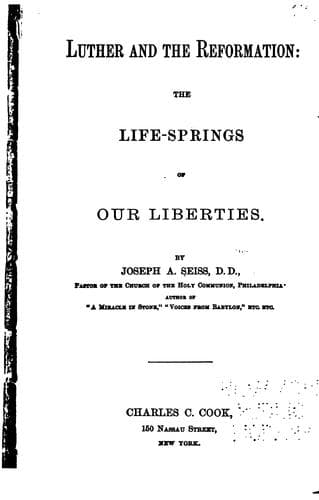
Luther and the Reformation:: The Life-Springs of Our LibertiesSeiss, Joseph Augustus
History
Luther and the Reformation:: The Life-Springs of Our Liberties
Seiss, Joseph Augustus
Luther, Martin, 1483-1546; Pennsylvania -- History -- Colonial period, ca. 1600-1775
The Saxon Elector, Frederick the Wise, was the worthiest, most
popular, and most influential ruler then in Europe. He could have been
emperor in place of Charles V. had he consented to be. The history of
the world since his time might have been greatly different had he
yielded to the general desire. His principles, his attainments, his
wisdom, and his spirit were everything to commend him. He founded the
University of Wittenberg in hope that it would produce preachers who
would leave off the cold subtleties of Scholasticism and the
uncertainties of tradition, and give discourses that would possess the
nerve and power of the Gospel of God. He sought out the best and most
pious men for his advisers. He was the devoted friend of learning,
truth, and virtue. By his prudence and foresight in Church and State
he helped the Reformation more than any other man then in power. Had
it not been for him perhaps Luther could not have succeeded. But it
was not in the nature of things for the noble Elector to give us such
a Reformation as that led by his humble subject. It is useless to
speculate as to what the Reformation might have become in his hands;
but it certainly could never have become what we rejoice to know it
was, while the probabilities are that we would now be fighting the
battles which Luther fought for us three and a half centuries ago.
REUCHLIN.
Reuchlin was a learned and able man, and deeply conscious of the need
of reform. When the Greek Argyrophylos heard him read and explain
Thucydides, he exclaimed, "Greece has retired beyond the Alps." He was
the first Hebrew scholar of Germany, and served to restore the Hebrew
Scriptures to the knowledge of the Church. He held that popes could
err and be deceived. He had no faith in human abnegations for
reconciliation with God. He saw no need for hierarchical mediations,
and discredited the doctrine of Purgatory and masses for the dead. He
bravely defended the cause of learning against the ignorant monks,
whom he hated and held up to merciless ridicule. He was a brilliant
and persuasive orator. He was an associate and counselor of kings. He
gave Melanchthon to the Reformation, and did much to promote it.
Luther recognized in him a great light, of vast service to the Gospel
in Germany. But Reuchlin could never have accomplished the
Reformation. The vital principles of it were not sufficiently rooted
in him. He was a humanist, whose sympathies went with the republic of
letters, not with the wants of the soul and the needs of the people.
When he got into trouble he appealed to the pope. And though he lived
to see Luther in agonizing conflict with the hierarchy of Rome, he
refrained from making common cause with him, and died in connection
with the unreformed Church, whose doctrines he had questioned and
whose orders he had so unsparingly ridiculed.
ERASMUS OF ROTTERDAM.
Public-domain text, read in full here on John Shaqi.
Reviews
Reviews
No reviews yet
Be the first to share your thoughts on this work.
Join the Discussion
Join the discussion
Sign in to leave a comment or review.
Sign InorCreate an account