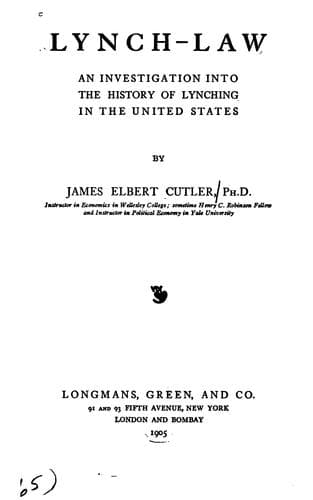
Lynch-law; an investigation into the history of lynching in the United StatesCutler, James Elbert
Philosophy
Lynch-law; an investigation into the history of lynching in the United States
Cutler, James Elbert
Lynching -- United States
In 1843 the practice of employing lynch-law in frontier settlements was
justified in the following way: “Until the law ... is completely
established the Lynch tribunals assert a concurrent jurisdiction, so to
speak, with the ordinary courts; and this jurisdiction they preserve
until the population loses the habit of resorting thereto, and acquires
that of confiding in the protection afforded by the legal tribunals; a
change of habit which takes place, we believe, as soon as those
tribunals have power to protect. In a new and thinly peopled country
every man feels that he may at any time be called upon to act as his own
protector. A habit of self-reliance is thus generated which time alone
can convert into a habit of relying upon the law.”[227]
In a book descriptive of border life in Texas, which was published in
1852, the frontier type of lynch-law received the following
justification:
“It is the stern primary law of self-preservation—this border custom
of bringing criminals before the whole body of citizens for
judgment—from which men sitting beside law-guarded hearths recoil in
dismay, and hearing only its cruel side, stigmatize as the utterly
unpardonable Lynch Law. Most true it is, that nothing but urgent and
deplorable necessity will drive a just and merciful man to participate
in its tribunals, but it is not less true that in frontier
settlements, if the fear of its quick vengeance did not overawe the
wicked, the innocent and peaceful would be in hourly danger of wrong
and outrage....
“The wild verdicts borderers sometimes enact, in the faith that they
are just and needful, sound uncouthly to those fenced round with
regular courts, and must seem dreadful to Christian men accustomed to
the solemn decorum with which constituted courts deal out their legal
awards of chains, lashes, and hangings; yet, seen close at hand, with
a knowledge of the situation of the community, and of the life and
deeds of the evil-doer, many of Judge Lynch’s verdicts will appear
more just and necessary than half of the sentences of the regular
courts....
“Statute law is but the formal expression of what the larger community
deems wisest and most just for the general welfare, the small, crude,
remote settlement does the same for itself; only without writing down
its enactments, and in the more summary way enforced by its peculiar
situation. It has no prison houses in which to detain a criminal, no
courts in which to try him, no funds wherewith to support him in long
duress. If a crime is committed the accused has the whole community
for judges and jury, and if he is found guilty by common suffrage they
proceed to execute the verdict.”[228]
Public-domain text, read in full here on John Shaqi.
Reviews
Reviews
No reviews yet
Be the first to share your thoughts on this work.
Elsewhere in the archive
Join the Discussion
Join the discussion
Sign in to leave a comment or review.
Sign InorCreate an account