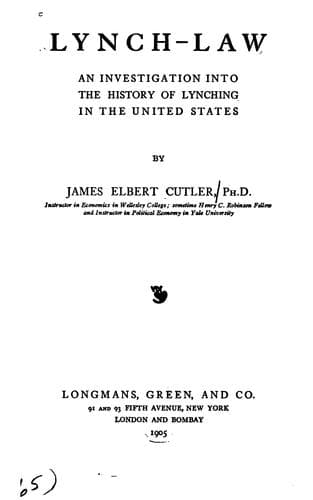
Lynch-law; an investigation into the history of lynching in the United StatesCutler, James Elbert
Philosophy
Lynch-law; an investigation into the history of lynching in the United States
Cutler, James Elbert
Lynching -- United States
Another writer carries the vindication of the frontiersmen and pioneers
still further by attributing culpability to the United States government
for not providing remote settlements with legal tribunals, so that
recourse to lynch-law would have been unnecessary. He writes: “The
greater share of the sin and disgrace falls upon the government, which
leaves to its citizens a heavy and responsible office, that ought to be
guarded by all the solemnities and securities of law.”[229]
Such are the arguments and the lines of reasoning by which the operation
of lynch-law previous to the Civil War was generally justified.[230]
Vindication was urged on grounds of necessity or self-preservation and
the nature of the offense, and it was lynch-law as applied to whites
that was thus vindicated.
The anti-slavery agitation and the emancipation of the slaves brought to
the support of lynch-law procedure another factor—that of race
prejudice. The number of negroes lynched in recent years as compared
with the number of whites lynched has indicated so clearly the existence
of race prejudice that many writers have given to it the chief place
among the causes of lynchings. It is a mistake, however, to consider
this race prejudice as of recent origin in the United States.
Race prejudice between the whites and the negroes in this country began
with the landing of the first ship-load of slaves in Virginia. In
describing the condition of the negroes in the colony of Virginia,
George W. Williams says: “It was not a mitigating circumstance that the
white servants of the colony who came into natural contact with the
Negroes were ‘disorderly persons,’ or convicts sent to Virginia by an
order of the King of England. It was fixed by public sentiment and law
that there should be no relation between the races. The first
prohibition was made September 17, 1630. Hugh Davis, a white servant,
was publicly flogged ‘before an assembly of Negroes and others,’ for
defiling himself with a Negro. It was also required that he should
confess as much on the following Sabbath.... All intercourse was cut off
between the races. Intermarrying of whites and blacks was prohibited by
severe laws. And the most common civilities and amenities were frowned
down when intended for a Negro. The plantation was as religious as the
Church, and the Church was as secular as the plantation. The ‘white
Christians’ hated the Negro, and the Church bestowed upon him a most
bountiful amount of neglect.”[231]
Public-domain text, read in full here on John Shaqi.
Reviews
Reviews
No reviews yet
Be the first to share your thoughts on this work.
Elsewhere in the archive
Join the Discussion
Join the discussion
Sign in to leave a comment or review.
Sign InorCreate an account