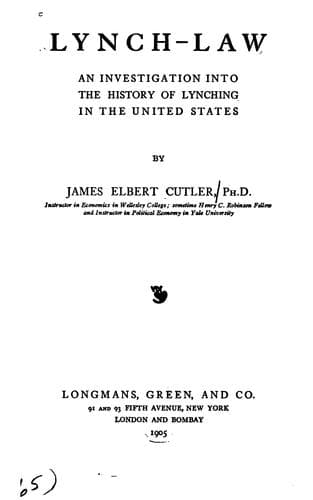
Lynch-law; an investigation into the history of lynching in the United StatesCutler, James Elbert
Philosophy
Lynch-law; an investigation into the history of lynching in the United States
Cutler, James Elbert
Lynching -- United States
To this view of the matter there is an apparent objection. It would seem
that if race prejudice existed during the time of slavery, it should
have manifested itself in the form of summary treatment of the negroes
more frequently than it did. In general, however, there was no occasion
for its manifestation. So long as the blacks were valuable as slaves and
accepted their inferior position without protest, no one wanted to get
rid of them or put them to death. The fact that slaves were property,
and in that capacity were amenable to the laws, made recourse to
unlawful procedure against them both unwise and unnecessary. It was only
in cases of insurrection among the slaves, or when some especially
brutal and barbarous crime was committed by a negro, that summary
measures were adopted prior to the Civil War. At such times negroes were
killed without mercy, sometimes they were tortured and their bodies
mutilated while still alive, and occasionally they were burned to death.
But these were extraordinary occasions; ordinarily the law was allowed
to take its course.[238]
A careful study of the relations which existed between the two races
from 1619 to 1860 will reveal the presence of more or less racial
antipathy. The institution of slavery, however, acted as a check to the
manifestation of this antagonistic feeling as regards the manner of
procedure for the punishment of negroes accused of serious offenses.
“Slavery was, in its way, a thoroughgoing school; the negro race was
educated in the cotton-fields and cabins of the South. In the Old South
there was very little negro crime and no negro idleness. The negro
worked under direction; he was taught how to work; he cheerfully
accepted his work, and he was the soul of fidelity, as the history of
the war proved.”[239] Restraints were placed around him; he received
protection and guardianship; and, above all, he received an industrial
training which gave him some degree of control over his own impulses and
actions. He was looked upon and governed as a child, and he was punished
as a child when he committed a breach of the peace or some serious
offense against person or property. The legal procedure for the
punishment of negroes, based upon the property right in slaves, was in
perfect accord with the order of society that had been established
during two hundred years or more of slavery.
Public-domain text, read in full here on John Shaqi.
Reviews
Reviews
No reviews yet
Be the first to share your thoughts on this work.
Elsewhere in the archive
Join the Discussion
Join the discussion
Sign in to leave a comment or review.
Sign InorCreate an account