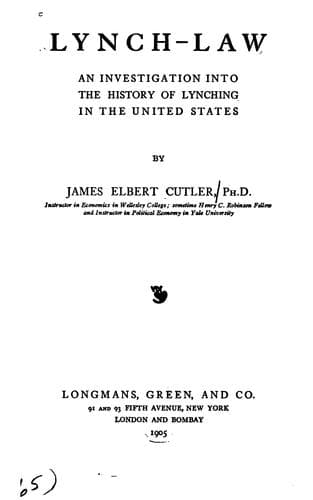
Lynch-law; an investigation into the history of lynching in the United StatesCutler, James Elbert
Philosophy
Lynch-law; an investigation into the history of lynching in the United States
Cutler, James Elbert
Lynching -- United States
When the institution of slavery was attacked in the early thirties and
during the years of controversy which followed, and still more when it
was finally overthrown in the sixties, race prejudice began to manifest
itself in the manner of treatment accorded negro criminals. By the
emancipation of the slaves in 1863, under the existing conditions,
absolutely no restriction was left upon its manifestation, for the
property right in the negro had been swept away and the great mass of
the negroes, finding all the old restraints suddenly removed, naturally
mistook liberty for license and committed many excesses. Large numbers
of negroes ceased to work. “The worst instincts of the negro came to the
front; the percentage of criminals among negroes increased to an
alarming extent; many were guilty of crimes of violence of the most
heinous and repulsive kind.”[240] The result of emancipation had not
been fully anticipated and no adequate legal provision was made for the
control of the freedmen. The foundation had been removed from the old
legal system and no new system was established in the place of the old
one which to any degree could cope with the condition of affairs.
Further, not only did the emancipation of the slaves leave no
restriction upon the manifestation of race prejudice in the form of
summary procedure against negro criminals, but the sudden elevation of
the negroes to political equality with the whites directly encouraged
its display. “Two hundred years or more of slavery educated both the
white and the black to a fixed order of society, in which the negro was
the servant and the white man the master. In one generation, through as
devastating a war as any country ever experienced, slavery was
abolished, the vast property interests in the slave destroyed, the
structure of society reversed, the master put at the bottom and the
slave at the top.”[241] In the light of subsequent history a greater
mistake could scarcely have been made than that of giving the elective
franchise to the newly emancipated slave. He was far from being a fully
developed man capable of exercising the duties of citizenship in a
democratic government, but in the legal institutions which were
established in the South during the period of Reconstruction it was
assumed that he was entitled to an equal share in the government with
his former master. A legal system was established which had no basis in
the order of society then existing. The result was enmity and bitterness
between whites and blacks at a time when there should have been sympathy
and forbearance, and summary and illegal measures were adopted by the
whites to prevent negro domination.
Public-domain text, read in full here on John Shaqi.
Reviews
Reviews
No reviews yet
Be the first to share your thoughts on this work.
Elsewhere in the archive
Join the Discussion
Join the discussion
Sign in to leave a comment or review.
Sign InorCreate an account