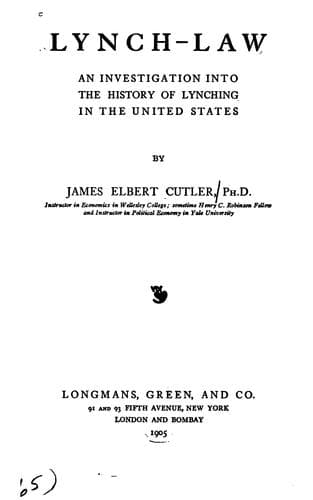
Lynch-law; an investigation into the history of lynching in the United StatesCutler, James Elbert
Philosophy
Lynch-law; an investigation into the history of lynching in the United States
Cutler, James Elbert
Lynching -- United States
Any one who would deal intelligently with the questions presenting
themselves in the South to-day must recognize the existence of a racial
prejudice. In some respects it is an unreasoning prejudice, a prejudice
in the extreme sense of the word, but there is also a real and
substantial basis for such racial antipathy, and it is a feeling which
is not likely to disappear for generations to come. It must be taken
into account in the consideration of all remedies proposed for existing
evils in the South. It is something that cannot be removed by
legislative enactments; neither can it be destroyed by constant crying
out against it. While it does not justify the lynching of negroes, it
does furnish a standpoint from which justification is easy, and it is a
fact which makes the prevention of such lynchings extremely difficult,
particularly where brutal crimes are committed upon whites by negroes.
The commonest justification for lynching negroes in recent years, the
plausibility of which rests very largely on race prejudice, is the crime
of rape as directed against white women. According to Tillinghast this
crime has come into existence since the Civil War, and its perpetrators
are overcome in many cases by primitive passions which master the
criminal’s whole being, a great fear being present also which impels to
murder.[242] Strictly speaking, this crime has not come into existence
since the Civil War. It is not a new crime to the negro. It has merely
increased and become more common along with the general increase in
criminality manifest in the negro race since emancipation.[243]
In colonial times laws were in force in a number of the colonies
providing for the punishment of rape committed by negroes on white
women, and there were numerous instances of the perpetration of this
crime.[244]
Public-domain text, read in full here on John Shaqi.
Reviews
Reviews
No reviews yet
Be the first to share your thoughts on this work.
Elsewhere in the archive
Join the Discussion
Join the discussion
Sign in to leave a comment or review.
Sign InorCreate an account