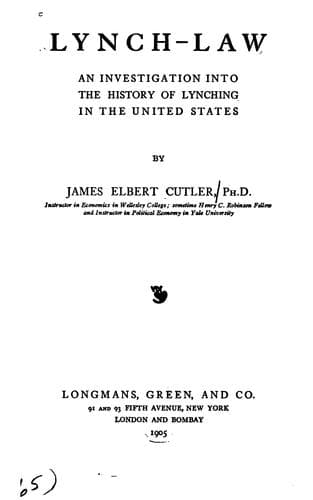
Lynch-law; an investigation into the history of lynching in the United StatesCutler, James Elbert
Philosophy
Lynch-law; an investigation into the history of lynching in the United States
Cutler, James Elbert
Lynching -- United States
In the year 1705 the Assembly of the Province of Pennsylvania enacted
that “WHEREAS some Difficulties have arisen within this Province, about
the Manner of Trial and Punishment of _Negroes_ committing Murder,
Manslaughter, Buggery, Burglary, Rapes, Attempts of Rapes ... it shall
and may be lawful for two justices of the Peace of this Province, who
shall be particularly commissionated by the Governor for that Service,
within the respective Counties thereof, and Six of the most substantial
Freeholders of the Neighbourhood to hear, examine, try and determine ...
and shall be punished by Death. And for an Attempt of Rape or Ravishment
on any white Woman or Maid, and for robbing, stealing, or fraudulently
taking and carrying away any Goods, living or dead, above the Value of
_Five Pounds_, every _Negroe_, upon Conviction of any of said Crimes,
shall be whipped Thirty-nine Lashes, and branded on the Forehead with
the Letter R or T, and exported out of this Province by the Master or
Owner, within Six Months after Conviction, never to return into the
same, upon Pain of Death, and shall be kept in Prison till Exportation
at their Masters or Owners or their own Charge.”[245]
By an act passed December 10, 1712, the colony of New York provided that
“all and every Negro Indian or other Slave, who ... shall murder or
otherwise kill ... or conspire or attempt the Death of any of Her
Majesty’s liege people, not being Slaves, or shall commit or attempt any
rape on any of said Subjects, or shall wilfully burn any dwelling-house,
barn, etc. ... or shall wilfully mutilate, mayhem or dismember any of
the said Subjects not being Slaves as aforesaid, or shall wilfully
murder any Negro, Indian or Mallatto Slave within this Colony, and shall
thereof be convicted before three or more of Her Majesty’s Justices of
the Peace ... in Conjunction with five of the principal ffreeholders of
the County wherein such fact shall be committed, ... or before any Court
of Oyer and Terminer or General Gaole Delivery ... shall suffer the
pains of Death in such manner and with such circumstances as the
aggravation or enormity of their Crimes in the Judgment of the Justices
of those Courts aforesaid, or as in the judgment of Seven of the said
Justices and ffreeholders they shall merit and require.”[246]
By an act passed March 11, 1713–14, the General Assembly of the Province
of New Jersey made the above enactment the law of New Jersey, and added
the provision that “if any Negro, Indian or Mulatto Slave shall attempt
to ravish any white Woman or Maid ... any two Justices of the Peace are
hereby authorized to inflict such corporal Punishment, not extending to
Life or Limb, upon such Slave or Slaves so offending, as to the said
Justices shall seem meet.”
Public-domain text, read in full here on John Shaqi.
Reviews
Reviews
No reviews yet
Be the first to share your thoughts on this work.
Elsewhere in the archive
Join the Discussion
Join the discussion
Sign in to leave a comment or review.
Sign InorCreate an account